


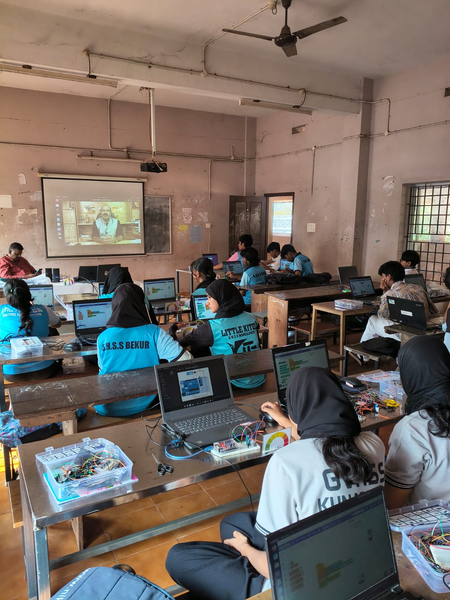
Nearly 15,000 students in Kerala are participating in the Little KITEs Sub-District Camps to learn about modern weather science and forecasting techniques. These students were selected from over 2.08 lakh members of 2,248 Little KITEs units for the two-day camps held at 225 centers. The focus of the camps is to provide hands-on training in programming, electronics, and digital content creation.
The students are engaged in developing functional prototypes of weather monitoring instruments and understanding the scientific principles behind professional weather forecasting centers. They are using robotic kits provided by the Kerala Infrastructure and Technology for Education (KITE) to design systems that can predict weather conditions based on inputs like temperature, air pressure, wind speed, and humidity.
During the programming sessions, students are creating working models of weather station equipment, including temperature gauges using LDR sensor modules, servo motors, and Arduino components. They are also building digital anemometers to measure wind speed and wind vanes to determine wind direction, applying classroom concepts to real-world scenarios.
Little KITEs, an initiative by KITE, the technology arm of the Kerala General Education Department, is known as India’s largest Student ICT Network with a membership exceeding two lakh. The program aims to foster innovation and technical skills among public school students, teaching them Artificial Intelligence, Robotics, Internet of Things (IoT), Animation, and encouraging them to be technology creators.
In the animation segment of the camp, students are creating digital content using OpenToonz, a free 2D animation software. They are learning advanced techniques like rotate animation, in-betweening, lip-syncing, tweening, and visual effects, and also developing 3D models using Blender. KITE’s Chief Executive Officer, K. Anvar Sadath, announced plans to introduce advanced robotic kits in all schools starting January 2026, enabling students to build sophisticated systems like mobile robots and smart weather stations.
