


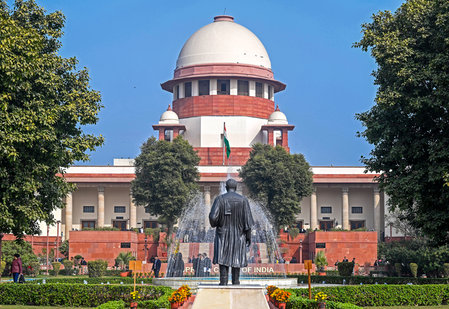
The Supreme Court has taken note of a Public Interest Litigation (PIL) requesting the implementation of the “creamy layer” principle within reservations for Scheduled Castes (SCs) and Scheduled Tribes (STs). The PIL, filed by former bureaucrat Gyanendra Kumar Khare, includes the Centre, state governments, Union Territories, and the National Human Rights Commission as respondents. It argues that the absence of the creamy layer exclusion within SC/ST reservations is arbitrary and violates the Constitution’s basic structure.
The petition highlights that reservations were meant as a remedial measure to address historical injustice and structural inequality, not as a permanent entitlement. It emphasizes that the lack of creamy layer exclusion leads to internal stratification within SC/ST communities, benefiting affluent families while depriving the most disadvantaged sections. The petitioner seeks directions for the identification and exclusion of the creamy layer to ensure affirmative action benefits reach those most in need.
The plea draws on Supreme Court judgments, including the Indra Sawhney vs. Union of India case introducing the creamy layer concept for Other Backward Classes. It also refers to the need for reservation benefits to reach genuinely disadvantaged sections. The petition mentions the recent Constitution Bench ruling recognizing that Scheduled Castes are not homogeneous and that sub-classification within them is constitutionally permissible.
