


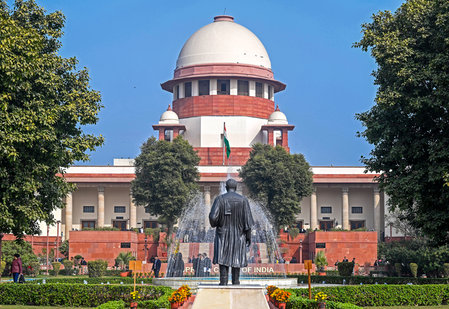
The Supreme Court has ruled that office bearers of a society can be prosecuted under the Negotiable Instruments Act if there is evidence of their involvement in financial transactions related to a bounced check. Justices Prashant Kumar Mishra and N.V. Anjaria partially allowed an appeal by M/s Mansi Finance (Chennai) Ltd. against a Madras High Court decision that dismissed criminal proceedings against four office bearers of Ravindra Bharathi Educational Society in a check bounce case. The apex court reinstated proceedings against the Society’s Vice-President, Treasurer, and Manager, while dismissing proceedings against an Executive Member due to lack of specific involvement in the transaction.
The dispute stemmed from a finance company allegedly providing Rs 4.5 crore to the educational society in 2018 for development purposes. A check worth over Rs 5.12 crore issued for repayment was dishonored in November 2019 with the notation “Account Blocked.” The Madras High Court had dismissed proceedings against the office bearers citing insufficient specific allegations in the complaint to establish vicarious liability under Section 141 of the NI Act.
The Supreme Court emphasized that being an office bearer alone does not warrant criminal liability under Section 141 of the NI Act. The court highlighted the importance of factual evidence linking the accused to the transaction, beyond mere designation. The Vice-President, Treasurer, and Manager were found to have signed various financial documents related to the transaction, forming a factual basis for prosecution. However, the Executive Member lacked a specific role in the transaction, leading to the dismissal of charges against him.
The court clarified that the determination of whether the office bearers were responsible for the Society’s affairs is a matter for trial evidence. It stressed that the judgment’s observations should not be construed as a verdict on the complaint’s merits, leaving all contentions open for the trial court to consider. The Supreme Court underscored that the truthfulness of allegations and evidence evaluation are not required at the quashing stage, reserving the assessment for trial proceedings.
