


Islamabad, Aug 11 (IANS) In its 2025 annual report, titled ‘Balochistan’s Crisis of Trust’, the Human Rights Commission of Pakistan (HRCP) noted that during its fieldwork in the province, it found locals concerned about the “escalating erosion of human rights and civic space in Balochistan. Discussions revealed a convergence of structural exclusion, gendered vulnerability, repression of youth voices and the weakening of public institutions”. The “structural exclusion” is not a recent development in the Islamabad-Balochistan relations but started as early as 1948 when the province was annexed after it had declared independence on August 11, 1947.
As Mohammed Hanif, a renowned novelist of Pakistan, had said in an interview, “Balochistan is considered a remote part of Pakistan not just geographically but in our imagination as well”. This is not a failure to incorporate the province but a deliberate attempt to chasten the Baloch so that they would not raise their voice and demand political and economic rights. Right from the outset, therefore, the policy has been military subjugation of this minority population of the country.
When the local population voted for the locals in 1972, and Sardar Attaullah Mengal became the Chief Minister, he was targetted for supporting and demanding rights for the locals; consequently, his government was dissolved, and he was sent to jail on flimsy grounds. Later, when his son, Akhtar Mengal, became the Chief Minister in 1997, he was not even consulted by Islamabad when nuclear tests were conducted in Balochistan, the province he was the Chief Minister of. He resigned in protest. Later, when Akhtar protested against General Pervez Musharraf, he was charged with sedition and jailed.
The abysmal condition of political, economic and human rights in the largest province of Pakistan captures the politicisation of human rights within Pakistan aptly. Not only in the context of the states’ crackdown against Baloch activists and even political leaders, but also, and more importantly, its persistent persecution of the Baloch people and the protestors demanding recovery of missing Baloch people at the hands of the state and accountability of the security forces involved in the extrajudicial killings of the Baloch draw a picture where the othering of the Baloch has been a common practice. Not only are they maltreated, but they are treated as troublesome people, who can be chastened only by force.
Balochistan is the largest province of Pakistan, forming 43.6 per cent of the total area of the country. Its population density is the lowest, 42.90/km. The province is rich in natural resources, like gas, gold, copper, oil, precious stones, and chromite. Southern Balochistan, with a 770 KM coastline, makes up 70 per cent of Pakistan’s total coastline. Some reports suggest that the province is a treasure trove, with some even of the view that if untapped resources of Balochistan are used, Pakistan may not need foreign aid to address its economic crisis. The Gwadar Port, presented as a game changer for the country, is in Balochistan.
Despite being rich in natural resources, having a long coastline, and a low population, all the factors that should have helped in the development and welfare of the Baloch people, Balochistan remains the least developed province in Pakistan. It is the poorest province, with a poverty rate as high as 47 per cent, as compared to the national poverty rate of 28.9 per cent in 2024-25. The province has been demanding its due rights in its natural resources that are being exploited by Islamabad. In response, the Baloch have experienced state highhandedness and violation of their human rights.
In response to the state highhandedness and the atrocities committed by the Pakistan military, some decided to wage armed resistance and seek separation from Pakistan; others like Akhtar Mengal have remained politically active and tried to seek political accommodation and removal of the past grievances. Still others, like Dr Mehrang Baloch and others have taken the road of protest.
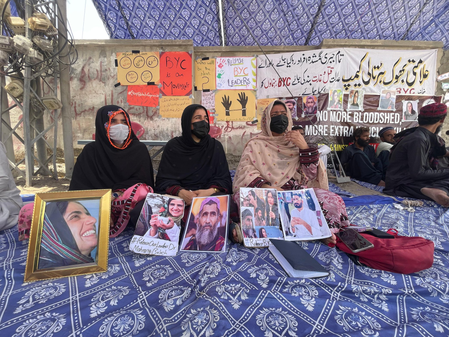
Due to this fragmented approach to the conflict from the Baloch, the Pakistani state legitimises the enemising of the Baloch, even the sections that have not taken up arms but engaged in political and legal ways of seeking a solution to the conflict, like protests. Thus, groups like Baloch Yakjehti Committee (BYC) and its members have been targetted and sent to jail.
In its 2023 fact finding report, ‘Balochistan’s Struggle for Hope’, the Human Rights Commission of Pakistan (HRCP) stated that attention needs to be paid “to the legitimate demands of the Baloch people” including, but not limited to, an end to enforced disappearance, extrajudicial killings, torture, ensuring press freedom in the province, giving the Baloch people due share in the rich natural sources of Balochistan, development and welfare in the province. Numerous such calls have been spurned disdainfully by the Pakistani state.
Perennial human rights violations of the indigenous Baloch people have continued. In June, according to the Human Rights Council of Balochistan, 63 enforced disappearances were recorded and 77 killings reported. This is in line with the latest statement issued by HRCP, which said: “Following a fact-finding mission to Balochistan, the HRCP has expressed grave concern over the human rights crisis confronting the province.”
In June, Mahrang Baloch, the head of the BYC, was sentenced to two life terms by an anti-terrorism court. Although Mahrang was arrested in March 2025 after being accused of having attacked Quetta hospital and “inciting people to violence”, she was sentenced in a different case in which she was accused of having given a provocative speech in Gwadar in July 2024 that led to violent protests and the killing of a security personnel. It shows arbitrary use of criminal law against the Baloch.
Mahrang and BYC have been active in raising the issue of Baloch enforced disappearances and human rights violations. BYC launched a march from Quetta to Islamabad in December 2023. Once they inched closer to the capital, these protestors became targets of the state on December 20 on the outskirts of Islamabad, where the police attacked them with water cannons and tear gas shells.
After being disappointed by the federal government in Islamabad, under her leadership, BYC organised rallies and protests across the province to raise awareness among the Baloch about their rights and unite against the state policies. The state, as a practice, saw these activities as a threat to its narratives. Therefore, it started a campaign against the BYC; subsequently, the BYC has been a target of the state, and almost its entire leadership has been sent behind bars.
This dynamic of Islamabad’s approach towards Balochistan exposes the discriminatory policy of Pakistan towards the Baloch. The human rights issue of Baloch people remains a critical issue to analyse how the Pakistani state has been legitimising their violations by using various tactics, from labelling the seekers a threat to the state to various tactical engagements or assurances without delivering on any.
None of the various civilian governments, military rulers or interim governments has ensured the human rights of the Baloch in the country, living under the domineering presence of the military-dominated Pakistani state. Since the day of the annexation of the province in 1948, the Baloch have been treated as subjects, not as citizens of Pakistan. Their resources are exploited and their rights denied. If anyone raises their grievances, they are profiled, labelled and punished for their acts.
–IANS
scor/as
