


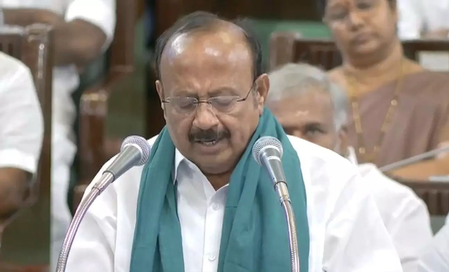
Tamil Nadu’s Agriculture and Farmers’ Welfare Minister, M.R.K. Panneerselvam, revealed that the state has effectively halted the decline in cultivable land due to climate change and natural disasters. Presenting the Interim Agriculture Budget for 2026-27, he allocated Rs 47,248.24 crore to the Agriculture and Farmers’ Welfare Department to reinforce the state’s commitment to agricultural development. The minister highlighted a rise in double-crop area to 13.99 lakh hectares in 2024-25, showcasing improved irrigation facilities and land management practices.
The budgetary allocation for agriculture in Tamil Nadu has seen a steady increase over the years, growing from Rs 34,220 crore in 2021-22 to Rs 45,661 crore in 2025-26. This increment of over Rs 11,000 crore in five years reflects the government’s emphasis on supporting the farming community. Panneerselvam emphasized that the enhanced allocation of Rs 47,248.24 crore for 2026-27 will sustain farmer welfare schemes and foster sustainable agricultural growth in the state.
Noting a significant improvement in the average Gross State Value Added (GSVA) growth in agriculture, the minister pointed out that the GSVA had risen from 1.36 per cent during 2012-13 to 2020-21 to 3.03 per cent between 2021-22 and 2024-25. This growth, translating to nearly 9.97 per cent at constant 2011-12 prices, indicates a stronger performance in the agricultural sector. Panneerselvam underscored the government’s focus on income enhancement and sustainability through various schemes aimed at enhancing productivity, ensuring food security, and boosting farmers’ incomes.
Under the Green Tamil Nadu Mission, the state has promoted agroforestry to increase tree and forest cover to 33 per cent. The government has produced and distributed 3.24 crore saplings over five years, bringing 2.24 lakh acres under agroforestry cultivation. Additionally, to address crop damage, measures such as culling wild boars and undertaking large-scale water conservation projects have been implemented. These initiatives include renovating traditional waterbodies, desilting irrigation canals, constructing check dams, establishing groundwater recharge structures, and planting saplings across various sites.
