


The Tamil Nadu government’s decision to categorize the proposed Parandur Greenfield Airport in Kancheepuram district as a ‘Special Project’ under the Tamil Nadu Land Consolidation Act has sparked worries among environmental groups and local residents opposing the project. The legislation, introduced by Revenue Minister Sattur Ramachandran, was swiftly passed in the State Assembly through a voice vote without discussion on the same day.
The Act, aimed at addressing land acquisition challenges for major infrastructure projects involving water bodies within the project area, was detailed on October 18, 2024. It empowers the government to merge contiguous land parcels of at least 100 hectares containing water bodies for commercial, industrial, or infrastructure ventures classified as ‘Special Projects’.
Upon receiving the ‘Special Project’ designation, a five-member expert committee, comprising four government officials and one environmental expert nominated by the government, is appointed. This committee engages in public consultations, formulates a draft land consolidation plan, and awaits final approval from the government through a gazette notification.
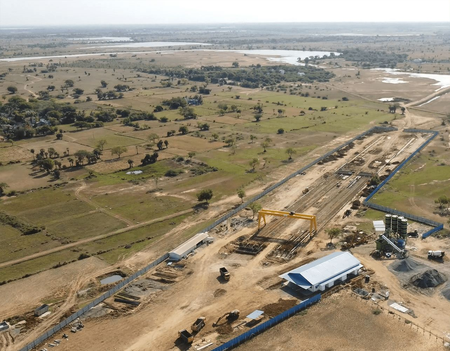
Environmentalists and activists argue that the framework favors project approvals and lacks adequate protection for ecological systems. The proposed Parandur Airport project, spanning over 2,172 hectares across 13 villages, encompasses wetlands, agricultural fields, and water bodies.
Experts caution that extensive construction in the area could disrupt natural drainage networks, groundwater recharge systems, and flood mitigation mechanisms. The region hosts a natural drainage channel connecting the Kesavaram dam with the Cooum River and a segment of the Kamban Canal, crucial for water distribution.
Environmental group Poovulagin Nanbargal has called on the State government to reconsider the project, highlighting climate change risks and potential harm to water ecosystems. Residents of Parandur and neighboring Ekanapuram continue to protest, fearing displacement and loss of fertile farmland due to the project’s implementation.
