


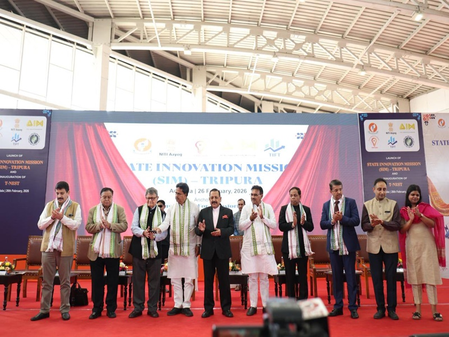
Tripura Chief Minister Manik Saha revealed plans for the state to introduce an Artificial Intelligence (AI) policy, marking a pioneering move in the country. The policy, developed with support from the Atal Innovation Mission and NITI Aayog, aims to enhance governance and technology-driven public services. This initiative follows the launch of the State Innovation Mission in Agartala, under the Atal Innovation Mission, to drive innovation-led development across states.
The AI policy will pave the way for AI-based solutions in Agartala, addressing various urban challenges such as traffic congestion, parking, power supply, water provision, flood control, and waste management. Additionally, Tripura is working on establishing an AI Centre of Excellence with assistance from the Union Ministry of Electronics and Information Technology to boost research, innovation, and capacity building.
Furthermore, the state government is planning to create a Tripura IT and Data Economic Zone to foster the IT, IT-enabled services (ITES), and data center ecosystem, aiming to attract investments in the digital economy. Chief Minister Saha highlighted the growing demand for software enterprises in Tripura, with plans to develop IT parks offering co-working spaces and integrated infrastructure within dedicated campuses.
Thursday marked a significant milestone in Tripura’s IT transformation journey with the launch of the State Innovation Mission, T-NEST (Tripura: Nurturing Entrepreneurship and Start-ups). Saha expressed optimism about Tripura becoming a regional hub for innovation and technology-led entrepreneurship. The State Innovation Mission aims to cultivate talent, promote cutting-edge technologies, and translate innovative ideas into impactful projects.
Union Minister of State Jitendra Singh commended Tripura for leading with the State Innovation Mission, setting an example for other states and Union Territories. He emphasized the significance of AIM in fostering innovation in governance and driving tangible outcomes. Singh highlighted the shift from traditional planning to innovation-led development, empowering states to play a more active role in growth.
