


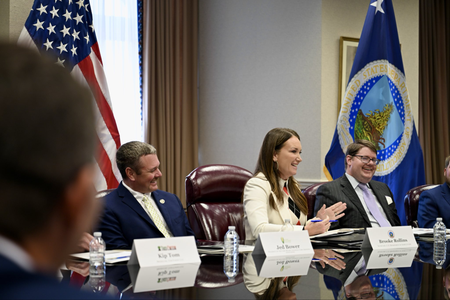
The Trump administration has requested $11.1 billion from Congress to assist American farmers facing challenges like rising production costs, falling farm income, and natural disasters. This includes $10 billion for temporary economic aid to row-crop and speciality-crop producers in 2026, along with $1.1 billion to help farmers recover from severe freezes. Agriculture Secretary Brooke Rollins presented the proposal to the Senate Appropriations Committee as part of a broader $87.6 billion funding request by President Donald Trump.
Rollins emphasized the importance of the supplemental funding, describing it as a crucial lifeline for Americans in need. She highlighted the financial pressures on producers amid ongoing efforts to secure trade agreements, expand biofuel markets, and relocate agricultural production back to the United States. Seed costs have risen by 19%, crop protection expenses by 30%, and fertiliser costs by over 50% between 2020 and 2025.
Farm income saw a significant drop of over $90 billion between 2023 and 2024, marking one of the largest annual declines on record. Republican Senator Mike Rounds noted that farmers were operating at a loss, projecting losses per acre in 2026 at $131 for corn, $342 for cotton, $114 for wheat, and $80 for soybeans. Senate Appropriations Committee Chair Susan Collins expressed concerns over the loss of 200,000 farms in the past decade, attributing it to various challenges faced by farmers.
Lawmakers from both parties urged support for farmers affected by disasters not covered in the administration’s proposal. While the request included aid for recent freezes, Collins questioned why earlier agricultural losses due to drought and excessive rainfall were not addressed. Rollins assured support for disaster relief programs, emphasizing the administration’s commitment to assisting farmers in times of need.
The administration highlighted positive trends in the agricultural economy, citing a 42% decrease in the agricultural trade deficit and the securing of 19 new trade agreements. US agricultural assistance programs typically include crop insurance, disaster payments, and temporary aid during periods of low prices or trade disruptions. Changes in US agricultural output and exports can impact global fertiliser markets, food prices, and animal-feed costs in major import-dependent economies in Asia.
