


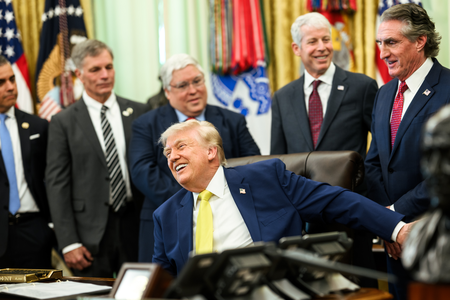
President Donald Trump has signed a national security directive aimed at speeding up the use of artificial intelligence (AI) in the US military and intelligence sectors. The directive focuses on deploying advanced AI systems more quickly and establishing new regulations for oversight, security, and accountability. This move is intended to provide American warfighters and intelligence professionals with cutting-edge AI capabilities while ensuring responsible usage.
The National Security Presidential Memorandum sets up a framework to empower the national security enterprise to swiftly integrate advanced AI models from various vendors. It also involves expanding secure computing infrastructure and enhancing access to technical expertise. Trump emphasized that AI is poised to be one of the most transformative technologies for US national security.
The directive outlines four key pillars for AI adoption in the national security enterprise: adoption, adaptation, assurance, and accountability. It instructs national security agencies to hasten the deployment of AI technologies, adapt commercial and open-source systems for government tasks, ensure system reliability and security, and uphold human accountability in AI-related decisions. Additionally, the memorandum mandates that no commercial entity or adversary should have the ability to disrupt or alter AI systems crucial for military missions without government approval.
Furthermore, Trump directed the Secretary of War to issue an updated directive on autonomy in weapon systems within 90 days, with annual reviews to keep pace with AI advancements. The memorandum also calls for the establishment of an AI National Security Strategic Reserve comprising non-governmental experts and encourages agency partnerships with private-sector firms to secure cutting-edge American AI technologies. Notably, the administration stressed that AI technologies used by national security agencies must not be misused for censorship, bias, or unlawful surveillance activities.
The directive replaces a previous framework issued during the Biden administration, with the White House citing bureaucratic hindrances and vendor dependence as drawbacks. This development aligns with global efforts to incorporate AI into military, intelligence, and cybersecurity operations. The US views AI as a critical technology with significant implications for national security, economic competitiveness, and strategic interests.
