


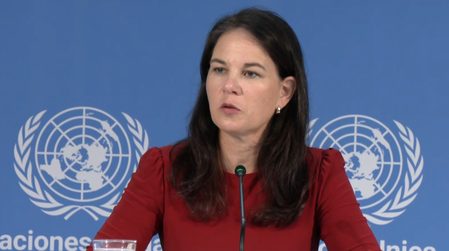
United Nations General Assembly President Annalena Baerbock highlighted the ongoing discussions regarding the reform of the United Nations Security Council (UNSC). She emphasized that progress has been made, with small steps being taken in this direction. Baerbock mentioned that P5 members are challenging the UN Charter at present.
Baerbock acknowledged the prolonged debate spanning over 17 years on reforming the Security Council. She noted the special responsibilities and veto rights of the five member states as outlined in the Charter. Various proposals, including those from the African Union, have been put forward for consideration to enhance the Council’s representation and credibility.
Addressing the selection process for the next UN Secretary-General, Baerbock assured a transparent and neutral approach under her leadership. She emphasized that each member state will have the opportunity to evaluate the candidates. The process, including hearings and town hall meetings, aims to engage a global audience in selecting a Secretary-General who serves the interests of all nations.
India’s consistent advocacy for UN reforms, particularly within the UNSC framework, underscores the necessity of adapting global institutions to effectively tackle contemporary challenges. The UNSC comprises 15 members, with five permanent members and 10 non-permanent members elected by the General Assembly for two-year terms. The current non-permanent members include Bahrain, Colombia, Congo, Greece, Denmark, Pakistan, Latvia, Liberia, Panama, and Somalia.
