


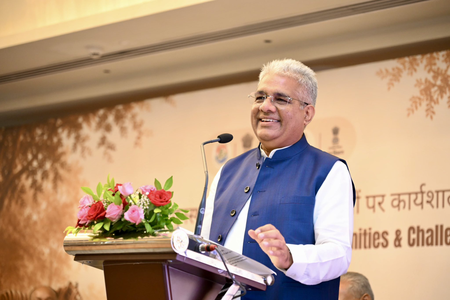
Union Minister for Environment, Forest and Climate Change Bhupender Yadav highlighted that tiger conservation goes beyond safeguarding a single species to preserving forests, watersheds, and diverse wildlife sharing the tiger’s habitat. Speaking at a National Workshop on “Tiger Re-introduction: Opportunities & Challenges” in Alwar, Rajasthan, he underscored the significance of involving local communities in conservation efforts. The workshop aims to facilitate discussions among wildlife experts and officials from various tiger landscapes in India to enhance tiger reintroduction and augmentation programs.
Describing the successful tiger reintroduction in Sariska as a pivotal moment in wildlife conservation, Yadav praised it as the first-ever scientific reintroduction of tigers in a region where they had vanished. He commended the program’s achievements in restoring the tiger population from local extinction in 2005 to 56 tigers presently, showcasing a global model for species restoration and community engagement. The Minister lauded India’s progress in tiger conservation, with the number of tiger reserves increasing from 46 to 58 in the last decade, surpassing the target of doubling the wild tiger population by 2022 set in the St. Petersburg Declaration.
Yadav emphasized the crucial role of community support in successful tiger reintroduction initiatives, citing the achievements in Panna and Sariska due to local participation. However, he highlighted the challenges faced in Satkosia Tiger Reserve, Odisha, where community backing was lacking. The Minister stressed the importance of community involvement in conservation projects like Project Cheetah, emphasizing the need to prioritize the welfare of local residents alongside promoting tourism. Additionally, he underscored the significance of maintaining landscape connectivity in areas where tiger and elephant habitats intersect.
