


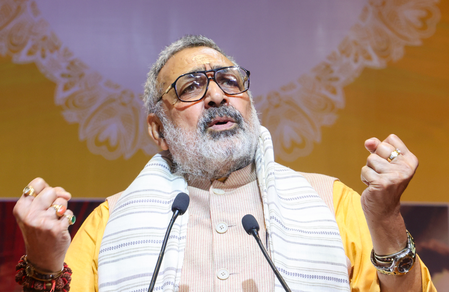
Union Textile Minister Giriraj Singh criticized AIMIM president Asaduddin Owaisi for his stance on the ‘love jihad’ matter, accusing him of promoting a “jihadi mindset.” Singh, speaking in Patna, highlighted Owaisi’s call for presenting love jihad data in Parliament, suggesting it should be addressed in Hyderabad first due to AIMIM’s influence there. He emphasized that the issue extends beyond personal relationships, alleging it as part of a deliberate strategy.
Giriraj Singh labeled the situation as more than just ‘love jihad,’ referring to it as a planned Ghazwa-e-Hind involving various forms of jihad. He further criticized Owaisi’s political ideology, stating that any influence resembling Jinnah’s in India would not succeed. Singh affirmed that no entity would be permitted to divide the country again, regardless of the schemes devised.
In response, Owaisi, speaking in Amravati, Maharashtra, challenged the government to provide concrete data on love jihad in Parliament. He questioned the government’s definition of love jihad and accused them of diverting attention from crucial issues like employment. Owaisi emphasized that individuals’ decisions should not be influenced by others’ opinions if they are adults.
Giriraj Singh also addressed allegations by Maulana Arshad Madani of Jamiat Ulema-e-Hind, rejecting claims that the Central government aimed to alter the Constitution. Singh asserted that the government’s objective was to uphold India’s essence, contrasting it with Madani’s alleged preference for Sharia law imposition. Madani, however, warned against the rising politics of hatred, emphasizing the need to preserve India’s secular fabric.
The interactions between these political figures underscore the growing intensity of debates surrounding identity, religion, and constitutional values in the national discourse.
