


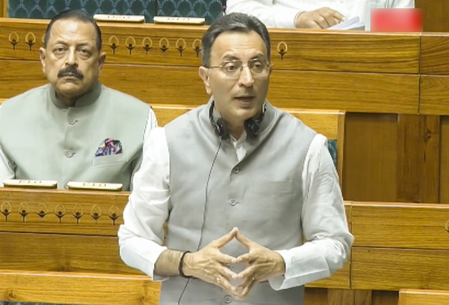
Union Minister of State for Electronics and IT, Jitin Prasada, shared that the IndiaAI Mission has incorporated over 38,000 GPUs and sanctioned 190 projects to enhance the nation’s artificial intelligence sector. Simultaneously, the Semicon India Programme has greenlit 10 semiconductor facilities to bolster local chip production.
Prasada informed the Lok Sabha that the initiative has integrated 38,231 GPUs via a shared compute facility, offering them to startups and academia at subsidized rates. Among the approved projects, 78 involve government bodies, 46 are with startups and MSMEs, and 30 are with early-stage startups, showcasing diverse participation.
The government is actively backing the growth of domestic AI capabilities, including processors and accelerators, through the National Supercomputing Mission utilizing the open-source RISC-V architecture. In tandem, the Semicon India Programme has endorsed 10 semiconductor manufacturing units, with one already operational and three in the pilot phase.
Tata Electronics is establishing a semiconductor fabrication unit in Gujarat with an investment of Rs 91,526 crore, aiming for a monthly capacity of 50,000 wafer starts across various technology nodes. To enhance chip design, the Design Linked Incentive (DLI) scheme has greenlit 24 semiconductor design projects, with 14 companies securing venture capital funding.
Additionally, the minister highlighted that 103 fabless chip design firms have received support for design infrastructure access, resulting in the fabrication of 7 chips out of 16 designs, including advanced nodes like 12 nm. The development of over 140 reusable semiconductor IP cores and filing of 10 patents have further fortified India’s design ecosystem.
On the AI front, the mission is aiding 12 organizations and consortia in creating indigenous foundational models, with some models already accessible on public platforms. The initiative is also fostering the global expansion of Indian startups, with 10 AI startups chosen for an international program in collaboration with French partners.
Moreover, 30 AI applications focusing on sectors like agriculture, healthcare, climate change, and disaster management have been identified, alongside 13 ongoing projects on responsible AI. The government’s support extends to 500 PhD scholars, 5,000 postgraduates, and 8,000 undergraduates, with 27 AI labs established in Tier-2 and Tier-3 cities and approval for similar facilities in 543 ITIs and polytechnics.
The IndiaAI Mission, launched with a budget of Rs 10,372 crore, aims to democratize high-performance computing access and aid startups, academia, and research institutions.
