


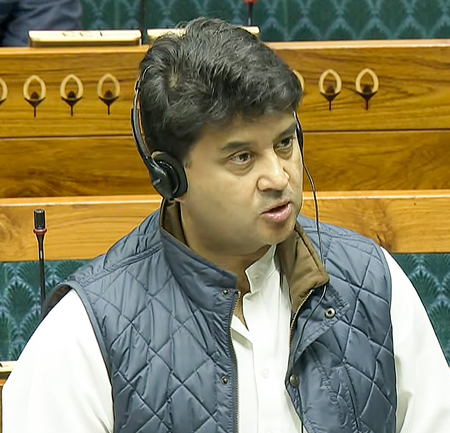
Union Minister for Communications and Development of North Eastern Region, Jyotiraditya Scindia, emphasized that BharatNet is pivotal in transforming India into a digitally inclusive society by enhancing broadband accessibility in rural areas. Describing BharatNet as a significant government-led initiative globally, he underscored the government’s dedication to ensuring internet access for all citizens.
Scindia pointed out the remarkable growth in mobile and broadband connectivity in India over the past eleven years, attributing it to a monumental digital revolution under Prime Minister Narendra Modi’s leadership. The BharatNet project, connecting gram panchayats through Optical Fibre Cable (OFC), has successfully brought online nearly 2.14 lakh out of 2.56 lakh gram panchayats, with an expenditure of around Rs 42,000 crore in Phases I and II.
In Tamil Nadu, Tanfinet, the state’s special purpose vehicle, is overseeing the implementation of BharatNet. Of the 12,525 gram panchayats in the state, 10,869 are already connected, with plans to cover the remaining gram panchayats and 4,767 non-gram panchayat villages under the revised BharatNet Programme, a $16.9 billion initiative recognized as the world’s largest government-led connectivity effort.
Scindia stressed the importance of state cooperation in enforcing Right of Way regulations and portals to expedite broadband expansion, ensuring citizens receive timely benefits. Additionally, he highlighted the launch of the National Broadband Mission (NBM) 2.0 on April 1, 2025, with ambitious targets set for accomplishment by 2030, including achieving OFC connectivity with 95% uptime in 42,000 villages by December 2025 and covering 2.7 lakh villages by 2030.
