


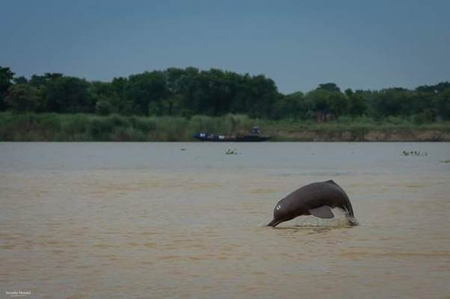
The Union Ministry of Environment, Forest and Climate Change has initiated the second rangewide estimation of riverine and estuarine dolphins under Project Dolphin from Bijnor, Uttar Pradesh. This effort follows the recent release of the first round’s population estimation results by Prime Minister Narendra Modi at Gir National Park in March last year. Union Environment Minister Bhupendra Yadav introduced the pan-India population estimation of dolphins and their protocol in Dehradun during the wildlife week.
A regional training workshop for forest staff from 13 districts of Uttar Pradesh was conducted in Bijnor, with plans for further training in every 10–15 districts to ensure standardized field capacity as the survey progresses. The survey, involving 26 researchers in three boats, focuses on recording ecological and habitat parameters using advanced technologies like hydrophones for underwater acoustic monitoring. The first phase will cover the Ganga from Bijnor to Ganga Sagar and the Indus River, while the second phase will include the Brahmaputra, Ganga tributaries, Sundarbans, and Odisha.
The survey aims to assess the status of various dolphin species, including the Ganges River Dolphin, Indus River Dolphin, and Irrawaddy Dolphins, along with evaluating habitat conditions, threats, and conservation-priority fauna. This comprehensive initiative seeks to provide scientific data supporting evidence-based conservation planning and policy action for India’s river ecosystems. The previous nationwide survey estimated around 6,327 riverine dolphins in India, with Uttar Pradesh and Bihar hosting the largest numbers, emphasizing the significance of the Gangetic basin for dolphin conservation.
