


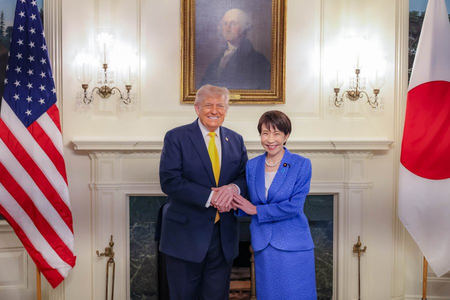
The United States and Japan have revealed plans for over $100 billion in energy and infrastructure investments, in addition to new defense and supply chain strategies, showcasing a stronger alignment in the Indo-Pacific region. President Donald Trump and Prime Minister Sanae Takaichi discussed various initiatives during their meeting at the White House to bolster the US-Japan alliance, enhance economic security, and reinforce deterrence in the area. A significant aspect of the announcement includes a substantial increase in Japanese investments in the US, with plans for small modular reactor projects in Tennessee and Alabama, as well as natural gas generation facilities in Pennsylvania and Texas.
The joint statement emphasized the importance of advanced reactors as a stable power source, aiming to stabilize electricity prices for Americans and enhance the technological leadership of Japan and the US globally. Both countries have agreed to enhance collaboration on supply chains, particularly focusing on critical minerals, with a new action plan set to expand production and diversify sources of essential inputs for strategic industries. Ambassador Jamieson Greer highlighted the significance of this plan in broadening the production and diversity of critical minerals, laying the groundwork for a binding plurilateral agreement supported by price floors and other measures.
Furthermore, the US will facilitate market access for agricultural exports to Japan and expedite visa processing for business travelers who contribute significantly to investments, workforce training, or knowledge transfer. The discussions also highlighted a commitment to advancing cooperation in technology and innovation, particularly in artificial intelligence, quantum technologies, and high-performance computing, involving collaborations between government agencies and private sector partners.
In the realm of space exploration, Japan will support NASA’s Artemis program with a crewed lunar rover, while both nations plan to extend their partnership in low Earth orbit and future Moon missions. Defense cooperation was a key focus, with Japan committing to bolster defense spending and military capabilities, along with plans to enhance missile defense cooperation and production of key systems. The leaders also reaffirmed their dedication to peace and stability in the Taiwan Strait and the complete denuclearization of North Korea.
