


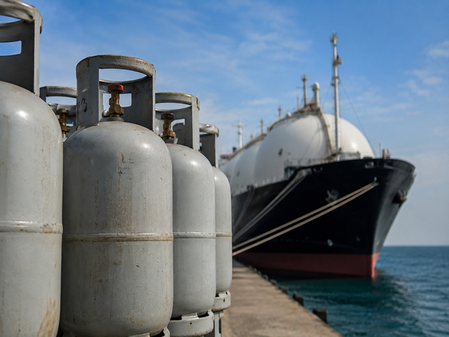
The United States has imposed extensive sanctions on a network accused of transporting Iranian liquefied petroleum gas (LPG) disguised as Omani fuel to various buyers in South and East Asia, including Bangladesh. The US Department of the Treasury’s Office of Foreign Assets Control (OFAC) revealed that the network utilized front companies in the United Arab Emirates and China, foreign bank accounts, and vessels associated with Iran’s shadow fleet to evade sanctions and mask the origin of Iranian LPG.
Treasury Secretary Scott Bessent stated, “Iran’s economy is floundering and its military is decimated.” Through its Economic Fury initiative, the Treasury aims to disrupt Iran’s shadow fleet, shadow banking networks, and global trade access. The network, allegedly run by Afghan national Sarbaz Abdul Zada and Turkish national Mohammad Shakol Mihandoust, operated UAE-based front companies that exported millions of barrels of Iranian LPG while misrepresenting it as Omani LPG.
The sanctioned companies named by OFAC include Butani Trading LLC, Dundlod Trading FZE, and ADH Energy FZE. Bangladesh was highlighted as a significant destination for several shipments identified in the sanctions action. Notably, in March 2026, ADH Energy FZE reportedly sold and exported millions of barrels of Iranian LPG to end users in Bangladesh. The vessel LPG SEVAN transported 750,000 barrels of LPG to Bangladesh between August and November 2025, as per the Treasury Department’s allegations.
Dundlod Trading FZE was accused of delivering 22,000 metric tonnes of LPG to Bangladesh in October 2025, valued at around $10.5 million, using the vessel GAS ZEINA. Additionally, the company allegedly conducted multiple LPG shipments to Bangladesh in May 2025 using another tanker. Several vessels implicated in transporting Iranian LPG have been added to OFAC’s Specially Designated Nationals and Blocked Persons List, including MD 23, GLENDALE, AMIR GAS, GAS LAGOON, MILE, and GAZ GMS, along with associated companies.
In a separate move, OFAC sanctioned Iran-based Mehrdad Geramian Nik and Partners Company, also known as Geramian Exchange, along with its leadership. The exchange house had contracts with sanctioned Iranian banks like Bank Tejarat, Bank Mellat, and Bank Pasargad, facilitating transactions involving hundreds of millions of dollars in foreign currency. Iranian exchange houses were described by the Treasury as a crucial part of the country’s sanctions-evasion network, utilizing brokers, shell companies, and overseas accounts to move funds while concealing ties to Iran.
