


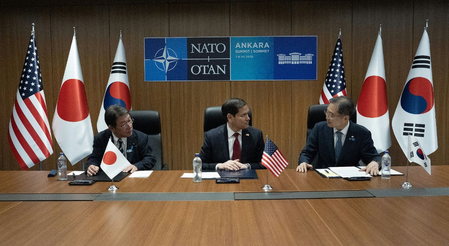
The United States, Japan, and South Korea have inked a trilateral deal to hasten the rollout of small modular reactors (SMRs) in other nations, with a primary focus on the Indo-Pacific region. This move signifies a significant advancement in their deepening strategic collaboration on energy security and civil nuclear technology. The Memorandum of Cooperation (MOC) was formalized during the NATO Summit in Ankara by US Secretary of State Marco Rubio, Japanese Foreign Minister Motegi Toshimitsu, and South Korean Foreign Minister Cho Hyun.
Energy security was highlighted as a critical global challenge by Rubio, who emphasized that the agreement reflects the tangible outcomes of the growing partnership among the three countries. Rubio expressed that the pact would propel collaborative efforts on small modular reactors, which are envisioned to shape the future of energy production in a secure, efficient, and cost-effective manner, ultimately bolstering their economies.
Rubio underscored that the agreement was a result of the trilateral engagement and showcased the forum’s ability to deliver concrete results. He also lauded the deepening ties between Japan and South Korea, noting the strengthening of their bilateral relationship despite past difficulties. The State Department noted that the memorandum establishes a framework for trilateral cooperation to expedite SMR deployment in other countries, aligning with the shared security interests of the three nations and assisting partner countries in meeting their energy security requirements.
