


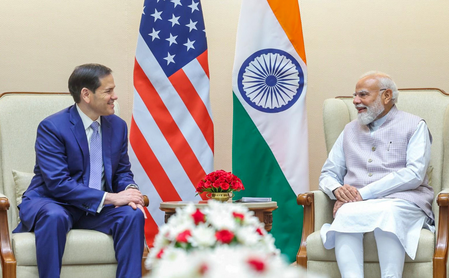
US Secretary of State Marco Rubio utilized his four-day visit to India to enhance Quad collaboration and affirm the Trump administration’s commitment to the Indo-Pacific as a strategic priority. Rubio, on his first visit to India in his current role, engaged in discussions with Prime Minister Narendra Modi, External Affairs Minister S. Jaishankar, and National Security Adviser Ajit Doval, in addition to participating in the Quad Foreign Ministers’ Meeting.
Dr. Vivek Lall, Chief Executive of General Atomics Global Corporation, described the visit as well-timed, emphasizing the importance of strategic dialogue and vision between the two nations. Lall noted the significant progress in defense cooperation, foundational agreements, and military exercises, indicating a strategic relationship with potential for further collaboration in defense and space sectors.
Highlighting the resurgence of the Quad, Lall mentioned the group’s momentum and specific deliverables over the years, emphasizing the importance of a common operating picture, surveillance, and security cooperation within the Quad partnership. Mukesh Aghi, President and CEO of the US India Strategic and Partnership Forum (USISPF), underscored Rubio’s visit as a reflection of the increasing significance of the Indo-Pacific in US geopolitical considerations.
Aghi emphasized the transition of the Quad partnership from symbolic diplomacy to deeper strategic and economic coordination, focusing on areas such as maritime security, critical minerals, energy, and resilient supply chains. Aparna Pande, Senior Fellow at the Hudson Institute, characterized Rubio’s visit as symbolically and substantively important, showcasing the strategic importance of India to the US.
US Ambassador to India Sergio Gor, who accompanied Rubio during the visit, described the meetings as productive, highlighting the successful conclusion of the visit with a significant Quad meeting. The Quad has become a key element of Indo-Pacific diplomacy, while India-US defense and technology ties have advanced through joint military exercises, semiconductor cooperation, critical minerals initiatives, and collaboration in emerging technologies.
