


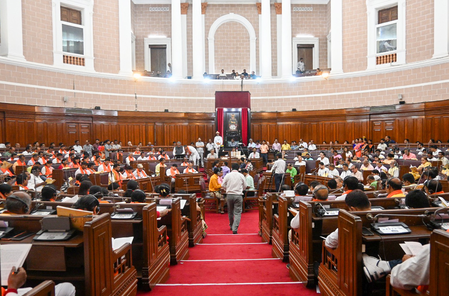
The Bharatiya Janata Party (BJP)-ruled government in West Bengal has unveiled the full Budget for the financial year 2026-27, signaling a shift towards investment-led growth and economic transformation, according to an SBI Research report. This budget highlights themes such as investment, governance, fiscal management, technology, entrepreneurship, tourism, and climate resilience, which were previously not as prominent. The focus now seems to be on industrialization, productive capacity creation, and long-term growth acceleration.
West Bengal’s fiscal situation has been strained, marked by increased debt accumulation despite receiving a higher share of Central Government grants. Over the years, grants from the Centre and tax devolution to West Bengal have consistently exceeded 50% of the state’s overall tax revenue. This trend is attributed to various factors like rising unconditional cash transfers, off-balance sheet borrowings, committed expenditure, and leakages in monetary resources due to middleman intermediation.
Dr. Soumya Kanti Ghosh, Group Chief Economic Adviser at the State Bank of India, highlighted the untapped potential for higher non-tax revenue in West Bengal. Improving general administrative efficiency is crucial for boosting non-tax revenues in the state. Additionally, West Bengal, being the seventh-largest in terms of coal-bed methane, has the potential to emerge as a hub for methanol production, leveraging its locational advantage in coal-bed methane and coal gasification.
The report suggests the establishment of an Eastern Multimodal Growth Corridor connecting Bihar, Odisha, West Bengal, and Assam through the integration of existing rail, road, port, and inland-waterway assets. In the Budget estimates for 2026-27, the revenue deficit is projected at Rs 21,984.41 crore, equivalent to 1.02% of the Gross State Domestic Product (GSDP), a decrease from the previous financial year’s revised estimates of Rs 41,164.05 crore.
