


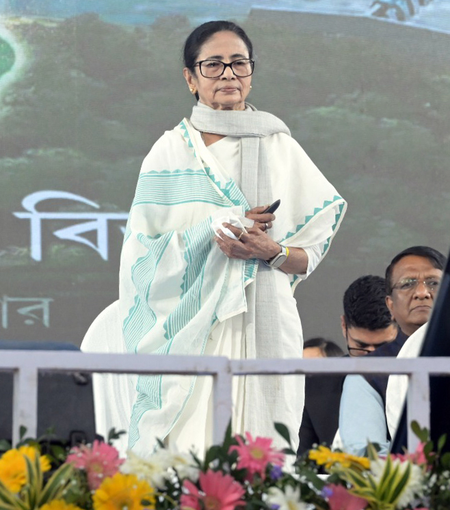
West Bengal Chief Minister Mamata Banerjee is scheduled to meet the Chief Election Commissioner (CEC), Gyanesh Kumar, at the Election Commission of India (ECI) headquarters in New Delhi on Monday. She will be heading to the national capital on Sunday afternoon, with a series of programs lined up, primarily focusing on the ongoing Special Intensive Revision (SIR) in the state.
Additionally, she is expected to engage with key leaders of opposition parties to build a consensus against the revision exercise. The timing of her visit to Delhi coincides with the presence of top opposition party leaders due to the ongoing Budget Session.
Party sources revealed that Mamata Banerjee strategically chose this period for her Delhi visit, anticipating the convergence of opposition party leaders during the Budget Session. While the exact date of her return to Kolkata is yet to be confirmed, insiders from the Trinamool Congress indicated that she would be back before February 5, aligning with the presentation of the “vote on account” in the West Bengal Assembly.
The upcoming budget session of the West Bengal Assembly holds significance, with the treasury bench set to introduce two crucial motions. One motion aims to denounce the activities of central investigative agencies like the Central Bureau of Investigation (CBI) and the Enforcement Directorate (ED) in the state. The second motion seeks to criticize the conduct of the ongoing SIR in West Bengal.
Anticipations suggest a contentious interaction between the Chief Minister and the CEC, following Mamata Banerjee’s strongly-worded letter to the CEC on Saturday. In her letter, she raised concerns about the authority of special roll observers (SROs) and micro-observers, highlighting their exclusive appointment in West Bengal for overseeing the SIR process.
Mamata Banerjee emphasized in her communication to the CEC that granting additional powers to micro-observers and observers had marginalized the electoral registration officers (EROs) and assistant electoral registration officers (AEROs), rendering them mere spectators. She argued that such empowerment of observers was contradictory to the democratic principles, federal structure, and fundamental rights enshrined in the Indian Constitution.
