


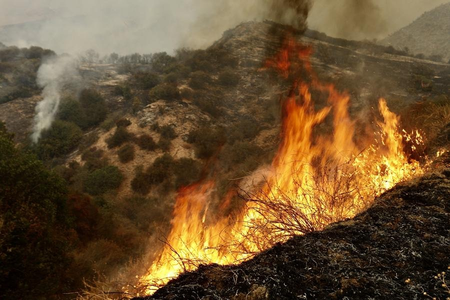
A wildfire in Iwate Prefecture, northeastern Japan, has grown to nearly 1,200 hectares, remaining largely uncontained since it started in Otsuchi Town’s mountainous area on Wednesday. The fire has already destroyed eight buildings, including homes, prompting evacuation orders for about 2,600 residents, which is a quarter of the town’s population. Helicopters and personnel from various agencies are engaged in firefighting efforts, with additional support requested from neighboring prefectures like Hokkaido and Fukushima.
Japan’s Meteorological Agency has issued a weeklong quake alert for 182 municipalities across seven prefectures, including Iwate, following a recent 7.7-magnitude earthquake. Authorities are emphasizing the need for earthquake vigilance alongside firefighting operations due to the heightened risks. The country’s dry periods in late winter and early spring, coupled with flammable vegetation, contribute to the rapid spread of wildfires, especially with the influence of seasonal winds.
The geography and vegetation of Japan, characterized by vast forested areas dominated by easily flammable coniferous trees like cedar and pine, pose a significant challenge in containing wildfires. Human activities, such as accidental ignition from campfires, agricultural burning, discarded cigarettes, and equipment sparks, also play a role in fueling these fires. The close proximity of human settlements to forested regions further escalates the risk of wildfires, necessitating heightened caution and preventive measures.
