


In this Hey Balwanth movie review, we dive into a film that arrives like a warm, mischievous gust of fresh air in Telugu cinema’s increasingly predictable comedy landscape. When was the last time a Telugu entertainer built its entire premise around a secret so intriguing that the curiosity itself became the biggest marketing hook? Hey Balwanth doesn’t just make you laugh — it makes you lean forward and wonder, right up until the moment it chooses to reveal its hand.
Debutant director Gopi Atchara announces his arrival with the kind of confidence that comes from having something genuinely original to say. This is Suhas doing what he does best — picking the script nobody else would touch and making it completely his own. Paired with a VK Naresh who looks like he’s been waiting for exactly this role his entire career, Hey Balwanth is the cinematic equivalent of a Guntur tiffin centre that looks unassuming from outside but serves something you’ll be talking about for weeks.
Hey Balwanth is a warm, entertaining Telugu comedy drama that succeeds brilliantly where it matters most — making you laugh, making you feel, and making you genuinely curious. A bold premise, standout performances from Suhas and VK Naresh, and a hilarious pre-interval stretch make this one of the most enjoyable Telugu theatrical experiences of early 2026
Language: Telugu
Age Rating: U/A
Genre: Comedy Drama
Director: Gopi Atchara
The Plot: A Family Secret That Is Worth Every Minute of the Wait
At its core, Hey Balwanth is a story about a father and a son — but calling it just that would be like calling Guntur mirchi just a chilli. The film’s smartest choice is its narrative engine: a son who has idolised his father his entire life, dreamed of joining the family business since childhood, and yet has absolutely no idea what that business actually is. His father Rao Balwanth (VK Naresh) has gone to extraordinary lengths to protect him from the truth — and therein lies the film’s emotional soul.
When Krishna Balwanth (Suhas) finally discovers what his father does for a living, the shock, conflict, and desperate desire to shut it all down set the story in motion. Complications pile on quickly — his idealistic girlfriend Mithra (Shivani Nagaram) who runs an NGO, two politicians with their own agendas, and an unshakeable love for a father he doesn’t know how to stop admiring. Set in Guntur, the film uses this premise to explore social stigma, paternal sacrifice, and the messy, beautiful complexity of family — all wrapped generously in Telugu comedy that actually lands.
The mystery around the father’s profession is the film’s most irresistible quality. It hooks you within the first few minutes and earns its payoff when it finally arrives.
Performances: A Cast That Gives Everything
Suhas — The Actor Telugu Cinema Deserves
This Hey Balwanth movie review must begin with what has become Suhas’s most reliable quality: his instinct for the unconventional. Where other actors chase formulaic safety, Suhas consistently gravitates toward the script that demands something more nuanced from him — and this is no exception. His Krishna Balwanth is funny, sincere, and emotionally grounded all at once. His comedy timing is effortless — not performed, but lived in. Watch him navigate the shock of discovering his father’s secret with the kind of layered reaction that lesser actors would oversell. He underplays it perfectly, and the result is a character you root for completely. This is Suhas at his most confident and most likeable.
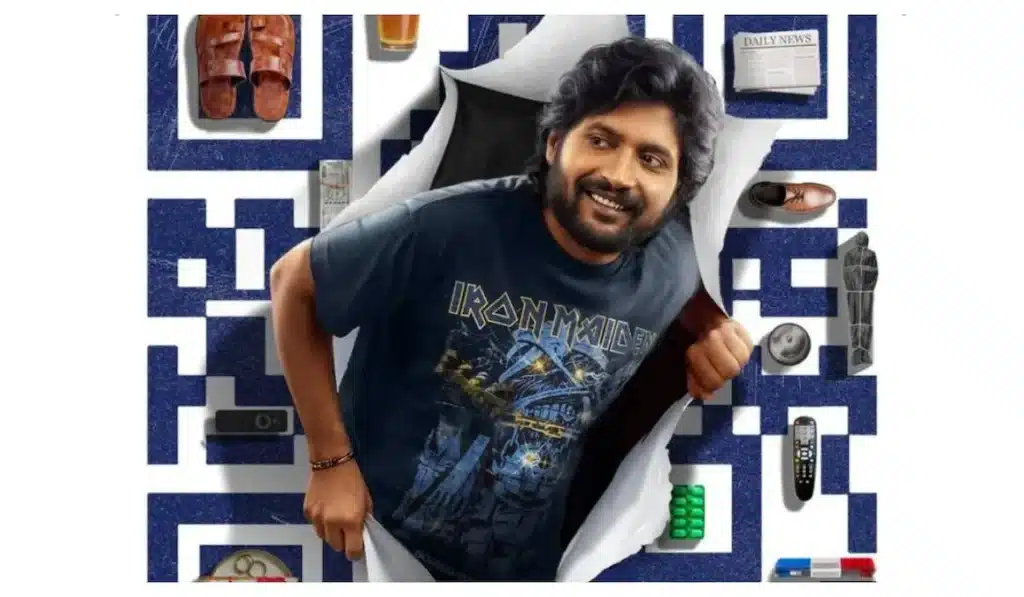
VK Naresh — The Undisputed Heart of the Film
Let’s address what anyone who’s seen Hey Balwanth will tell you: VK Naresh simply steals this film. His Rao Balwanth is one of the most warmly written and brilliantly performed father characters Telugu cinema has produced in recent memory. He carries the comedy and the drama with equal conviction — cracking you up in one scene and quietly breaking your heart in the next. There’s a tenderness to his performance that transcends the material. His chemistry with Suhas feels completely natural, like a father-son bond that existed long before the cameras rolled. This is VK Naresh reminding everyone exactly why he is irreplaceable in Telugu cinema.
Shivani Nagaram — Conviction in Every Frame
As Mithra, the idealistic NGO-running girlfriend who finds herself at the moral centre of the conflict, Shivani Nagaram brings warmth and sincerity to a role that could have been merely functional. She shares natural chemistry with Suhas and holds her own in the film’s more earnest moments. Her character deserved greater scope, and one hopes future collaborations give her that space — because the talent is clearly there.
The Supporting Ensemble — Everyone Gets Their Moment
Nellore Sudarshan is an absolute delight. His energetic delivery and sharp comic timing produce some of the loudest laughs in the film, and he brings a freshness to every scene he inhabits. Vennela Kishore, as reliably as gravity, delivers the comic relief that audiences have come to expect from him — and does not disappoint. The ensemble collectively understands that a comedy drama lives or dies by its supporting architecture, and they build it solidly.
Direction and Vision: A Debutant Who Came Prepared

Gopi Atchara makes the kind of debut that immediately signals a filmmaker worth following. His most impressive quality is restraint within ambition — he has an original idea, he executes it with clarity, and he trusts his cast to deliver. The first half of Hey Balwanth is a masterclass in sustained comic momentum. Scenes are constructed with purpose, laughs are earned rather than forced, and the central mystery is teased with just the right amount of discipline.
Where Atchara shows real promise is in blending social commentary with entertainment without either element feeling compromised. The film never lectures. It never pauses to explain itself. It simply tells its story and trusts the audience to feel the weight of what it’s saying. That kind of authorial confidence is rare in a debut, and it marks Gopi Atchara as a director whose second film will be eagerly anticipated.
The pre-interval sequence in particular is a reminder of what Telugu comedy can be when it’s working at full capacity — sharp, physical, well-timed, and completely committed.
Technical Brilliance: Craft in Service of Story
Cinematography: Grounded and Warm
Mahi Reddy Pandugula’s cinematography gives Hey Balwanth a visual identity rooted in the warmth of its Guntur setting. The frames feel lived-in and authentic — exactly the right choice for a story about ordinary people navigating extraordinary family secrets. The camera serves the performances rather than competing with them, which is precisely what this kind of comedy drama needs.
Music: Energy Where It Counts
Vivek Sagar’s background score drives the comedy portions with infectious energy, hitting the right notes during the film’s most entertaining stretches. The music understands when to push and when to step back, and in the film’s lighter moments, it adds genuine propulsion to sequences that are already working well.
Editing: Sharp Where It Matters
Viplav Nyshadam keeps the first half brisk and well-paced, maintaining the rhythm that the comedy requires. The second half carries a slightly heavier tonal burden and could have benefited from tighter cuts in a few places — but these are small refinements on an otherwise well-assembled film. The editing never lets you get comfortable enough to look at your watch.
Why Hey Balwanth Is Exactly What Telugu Comedy Needed Right Now
There’s a specific pleasure in watching a Telugu film that refuses to be safe. In an industry where comedy is often reduced to formula — the sidekick who falls, the hero who quips, the villain who bumbles — Hey Balwanth does something genuinely braver. It builds its entire story around a premise that makes you uncomfortable, then uses that discomfort to say something true and warm about family, sacrifice, and the impossible positions fathers put themselves in to protect the people they love.
For Gopi Atchara, this debut announces a real talent. His willingness to take a socially bold premise and package it as a crowd-pleasing entertainer, his instinct for honest performances over theatrical ones, his trust in the intelligence of Telugu audiences — these are the marks of a filmmaker who will only get better from here.
Strengths and Minor Areas for Improvement
What Works Magnificently
- VK Naresh’s career-defining performance — Warm, funny, deeply human, and impossible to look away from
- Suhas’s assured and charming lead turn — Proof that unconventional choices pay off
- A bold, original premise — The kind of story Telugu cinema rarely attempts
- That irresistible pre-interval stretch — Among the best Telugu comedy writing of 2026 so far
- Strong social commentary delivered without preaching — Embedded naturally in the entertainment
- Gopi Atchara’s confident directorial debut — A filmmaker who already knows who he is
- An ensemble that elevates every scene — Sudarshan and Vennela Kishore especially
Where It Could Grow
- The second half’s tonal shift could be smoother — The transition from comedy to emotional drama occasionally feels abrupt
- Shivani Nagaram and Harsha Vardhan deserve more narrative real estate — Their characters have more to give
- A few scenes in the final act run slightly longer than needed — Tighter cuts would sharpen the emotional impact
Final Verdict: 4/5 Stars ⭐⭐⭐⭐
Hey Balwanth is exactly what Telugu cinema needs right now — a film that remembers that bold choices and commercial entertainment are not mutually exclusive, that audiences are more than ready for stories that challenge them gently, and that the space between comedy and genuine emotion is where the most memorable films are made.
This Hey Balwanth movie review celebrates a film that succeeds far more than it stumbles. Yes, the second half could be tighter. Yes, a couple of supporting roles feel underwritten. But these are small complaints about a film that swings with real intention, entertains consistently, and delivers two of the most enjoyable Telugu performances you’ll see this season.
VK Naresh reminds us why he became a beloved constant in Telugu cinema — not through predictable choices but through brave, committed ones. Suhas proves once again that interesting scripts lead to interesting films. And Gopi Atchara announces himself as a voice Telugu cinema will be hearing a lot more from.
There’s a specific joy in watching a film that actually has something to say. In a landscape often dominated by safe, template-driven entertainers, Hey Balwanth feels like someone opened a window and let something genuine come through. It’s funny, it’s warm, it’s occasionally daring — and it’s absolutely worth your Friday evening in the theatre.
The boldness is intentional. The heart is real. And somewhere inside all that laughter is a genuinely moving love letter to fathers, families, and the secrets we keep to protect the people we love most.
What is the age rating of Hey Balwanth?
Hey Balwanth carries a U/A (Universal with Adult Supervision) certificate from the CBFC.
Can we watch Hey Balwanth with kids?
Hey Balwanth is best enjoyed by audiences aged 15 and above.
Is Hey Balwanth based on a true story?
No, Hey Balwanth is not based on a true story. It is an original fictional Telugu comedy drama written and directed by debutant Gopi Atchara
Why was Hey Balwanth originally called Hey Bhagawan?
The film was originally titled Hey Bhagawan, but the CBFC requested a title change before its release.
