


Every year when March approaches, there’s this particular evening that feels different. You’ll notice it in your neighborhood—people gathering wood, arranging cow dung cakes in careful pyramids, the air already tinged with anticipation. For those of us who grew up watching our grandmothers meticulously prepare for Holika Dahan, that smell of the bonfire mingled with incense becomes inseparable from the promise of spring and new beginnings.
Holika Dahan isn’t just the prelude to Holi’s riot of colors. It’s the spiritual anchor, the moment when we pause to remember why we celebrate at all. And in 2026, whether you’re lighting a bonfire in your backyard in New Jersey or gathering with your community at a temple in Toronto, knowing the exact muhurat and proper rituals helps you connect to something thousands of years old.
Quick Answer:
Holika Dahan 2026 falls on Monday, March 2nd, with the auspicious muhurat from 6:28 PM to 8:52 PM. This sacred bonfire ritual marks the victory of devotion over evil and precedes the colorful Holi celebrations. Perform the ritual with traditional offerings of grains, flowers, and coconut during the specified time for maximum spiritual benefits. The ash collected the next morning is considered purifying and auspicious.
When is Holika Dahan in 2026?
In 2026, Holika Dahan will be performed on Monday, March 2nd, the evening before Holi. The festival calendar sometimes shifts depending on the lunar cycle, so it’s worth double-checking each year rather than assuming it falls on the same date.
Auspicious Muhurat Timings
The most important aspect of Holika Dahan is performing it during the right time window. Here are the precise timings for 2026:
| Event | Date & Time (IST) |
|---|---|
| Holika Dahan Date | Monday, March 2, 2026 |
| Holika Dahan Muhurat | 6:28 PM to 8:52 PM |
| Muhurat Duration | 2 hours 24 minutes |
| Purnima Tithi Begins | 5:42 AM on March 2, 2026 |
| Purnima Tithi Ends | 3:22 AM on March 3, 2026 |
| Rangwali Holi (Dhulandi) | Tuesday, March 3, 2026 |
Note: These timings are based on New Delhi IST. If you’re in a different time zone or city, consult your local panchang or temple for region-specific muhurat times.
The muhurat timing matters because it avoids inauspicious periods like Bhadra Kaal, when it’s traditionally believed that starting new ventures or rituals can attract negative energies. Lighting the bonfire during the prescribed window ensures you’re aligned with the cosmic rhythms that make the ritual most effective.
Holika Dahan Rituals: Step-by-Step
If you’ve never performed Holika Dahan yourself, it might seem daunting. But the ritual, at its core, is straightforward—it’s about intention and presence more than perfect execution. Here’s how it typically unfolds:
Preparation Before Sunset
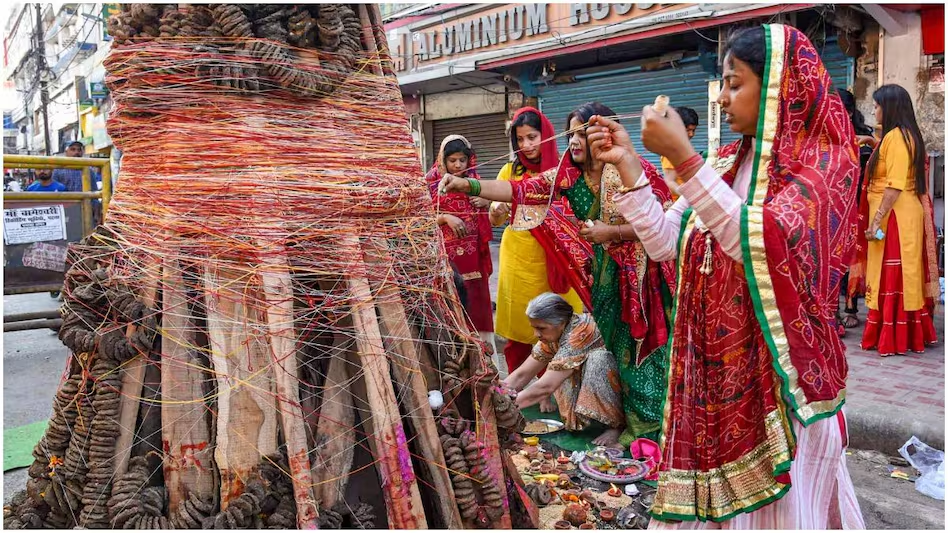
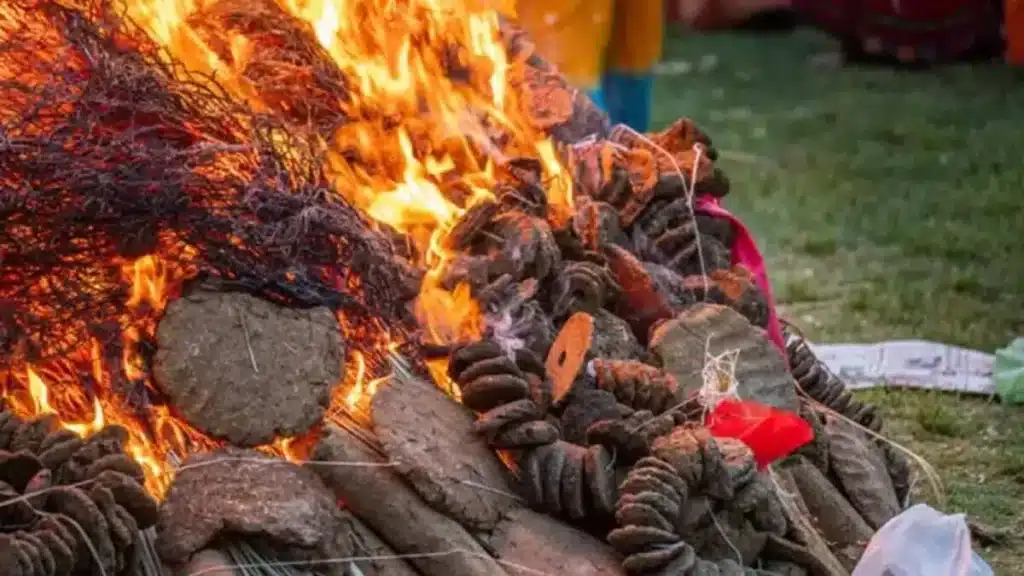
Days before Holika Dahan, the bonfire materials start accumulating. In India, you’ll see neighborhood committees organizing this; abroad, temple communities or groups of families often coordinate. The pyre is built from wooden logs and dried cow dung cakes, arranged to allow air circulation so the fire catches quickly. Sometimes a small symbol or idol representing Prahlad is placed within the structure, a visual reminder of the legend.
The area around the bonfire is cleaned and sometimes decorated with rangoli. If you’re doing this at home with family, even a small setup works—the size of the fire matters less than the sincerity of the prayers.
Sankalpa: Setting Your Intention
Before the fire is lit, take a moment for sankalpa—a conscious intention or pledge. This isn’t about reciting complex mantras unless that’s your tradition. It can be as simple as silently asking for protection for your family, strength to face challenges, or the courage to let go of old patterns that no longer serve you. The fire is about transformation, after all. What do you want to release? What do you want to purify?
Making Offerings to the Unlit Pyre
Before ignition, offerings are made to the bonfire. You’ll need water in a small pot or lota, fresh flowers, turmeric powder, kumkum (vermilion), and grains—wheat, gram, moong dal are traditional choices. Some families also offer coconut, jaggery, or batasha (those tiny sugar candies that remind you of childhood).
Walk around the unlit pyre, sprinkling water, scattering flowers and grains, applying turmeric and kumkum to the wood. You’re sanctifying it, turning ordinary materials into a sacred vessel for transformation.
Lighting the Fire During Muhurat
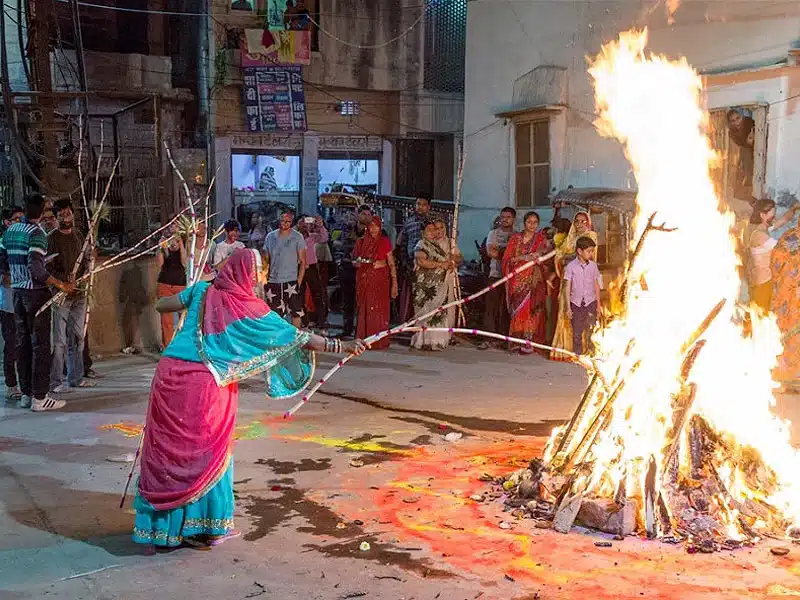
At precisely 6:28 PM on March 2, 2026, the bonfire should be lit. In community settings, this is often done by the eldest person or a priest, accompanied by Vedic mantras. If you’re at home, anyone in the family can do it—there’s no strict hierarchy when it comes to sincere devotion.
As the flames rise, you’ll feel the heat on your face, smell the smoke mingling with incense. There’s something hypnotic about watching fire dance, the way it never repeats the same movement twice. This is the moment to feel the presence of the divine, to remember Prahlad standing unharmed in the flames, protected by something larger than himself.
Parikrama: Circumambulation
Once the fire is blazing, devotees perform parikrama—walking around the bonfire three or seven times in a clockwise direction. With each circle, you’re offering more grains, flowers, perhaps a raw thread or moli (sacred string), sometimes pieces of fresh sugarcane or the first grains of a new harvest.
The circling is meditative, repetitive in a way that quiets the mind. Some people chant “Om Namah Shivaya” or prayers to their chosen deity. Others walk in silence, each rotation releasing something—worry, fear, old grudges, the accumulated weight of a difficult year.
Collecting Sacred Ash
The fire burns through the night, and by morning, it’s reduced to ash—gray, soft, still faintly warm. This ash, called vibhuti, is considered deeply sacred. People collect it to apply as a tilak on their foreheads, believing it purifies the body and soul, removes negative energy, offers protection.
There’s a beautiful symmetry to it. What was wood and flame becomes ash, and that ash becomes a blessing. Everything transforms; nothing is wasted.
Puja Essentials Checklist
If you’re planning to perform Holika Dahan at home or want to contribute to a community gathering, here’s what you’ll need:
Bonfire Materials
- Wooden logs (various sizes for structure)
- Dried cow dung cakes (important for traditional ritual)
- Dried leaves or hay to help ignition
Offerings for the Fire
- Grains: Wheat, mustard seeds, sesame seeds, moong dal, gram
- Sweets: Jaggery pieces, batasha (sugar candies)
- Produce: Fresh sugarcane pieces, barley or new crop grains if available
- Sacred thread: Raw yarn (kaccha soot) or moli
- Coconut: Dry coconut (copra)
Puja Items
- Water in a kalash (copper or brass pot if possible)
- Roli (vermilion powder) and akshat (unbroken rice grains)
- Fresh flowers—marigold and rose are traditional choices
- Garland for offering
- Dhoop (incense sticks) or camphor
- Small oil lamp or diya
- Turmeric and kumkum powder
- Bell for aarti
You don’t need everything on this list to perform a meaningful ritual. Use what’s available to you. The spirit of devotion matters infinitely more than having every traditional item perfectly arranged.
Celebrating Holika Dahan Abroad
For those of us living far from India, Holika Dahan can feel like a thread connecting us to home. I remember the first time I tried to organize one in my apartment complex in California—we had to get permits for the bonfire, coordinate with the fire department, explain to bemused neighbors what we were doing. But when that fire finally caught and we stood around it with our small community, kids running circles with sparklers, someone’s grandmother leading prayers in a shaky but determined voice, it felt like we’d transported a piece of home across oceans.
If local regulations don’t permit bonfires, some communities hold symbolic ceremonies indoors or at temples, lighting smaller fires in designated areas. The form adapts, but the meaning—purification, community, renewal—remains intact.
Many temples in North America, the UK, Australia, and other countries with significant Indian diaspora populations organize Holika Dahan events. Check with your local temple or Indian cultural association. These gatherings become more than religious observance; they’re where your children meet other kids who understand why they smell like incense, where you find the uncle who knows the proper way to tie a dhoti, where you remember you’re not alone in trying to keep these traditions alive in foreign soil.
The Day After: Rangwali Holi

When you wake up on March 3rd, 2026, the day after Holika Dahan, the air feels different—lighter, charged with permission to be playful. This is Rangwali Holi, Dhulandi, the day Krishna colored Radha’s face and everyone joined in until the whole world was splashed with joy.
The morning often begins with prayers and sometimes a Satyanarayan Puja, grounding the day in devotion before the revelry starts. Then comes the explosion of color—gulal in every shade, water balloons arcing through air, music blasting, sweets making the rounds. Gujiya, those crescent-shaped pastries stuffed with khoya and dry fruits. Thandai, that creamy drink spiked with bhang in some regions, though most diaspora communities stick to the non-intoxicating version.
For many, this is when the spiritual meaning of the previous night’s fire manifests in physical form. You’ve burned away the old; now you’re painting yourself and everyone around you in newness. The colors that wash off your skin in the shower later are temporary, but the renewal they represent—that has a chance to stick.
Dos and Don’ts for a Meaningful Celebration
Embrace these practices:
- Use organic, natural colors whenever possible. Those chemical-laden synthetic colors might be brighter, but they’re harsh on skin and terrible for the environment. Plus, the traditional gulal made from flowers and natural pigments connects you more directly to how the festival was celebrated for centuries.
- Start Holi morning with prayers or a simple puja. It sets a tone, reminds you this isn’t just a party—it’s a sacred celebration that happens to be incredibly fun.
- Make traditional foods if you can. Even if your gujiyas don’t look Instagram-perfect, the act of making them connects you to your mother, your grandmother, everyone who shaped and fried these same sweets before you. And if cooking isn’t your thing, buy them from an Indian store or bakery—supporting diaspora businesses is its own form of community building.
- Visit friends and family, exchange sweets and blessings. In our screen-dominated age, Holi gives permission to show up at someone’s door unannounced with a box of sweets and colored powder, to hug people you haven’t seen in months, to rebuild connections that have frayed.
Avoid these pitfalls:
- Don’t force colors on anyone who doesn’t want to play. Consent matters, even in celebration. Some people have skin sensitivities, religious reasons, or simply personal preferences for staying out of the color chaos. Respect that.
- Keep children safe around the bonfire. It’s beautiful and sacred, but it’s also fire. Supervise kids closely, maintain a safe perimeter, don’t let the ritual become a tragedy.
- Don’t waste water unnecessarily. The irony of celebrating spring while depleting a precious resource isn’t lost on anyone. Use water mindfully, maybe play with dry colors instead of drenching everyone, find balance between tradition and responsibility.
- Avoid synthetic colors that can cause allergic reactions or take days to wash off. Your skin will thank you, and so will the person who has to go to work the next day with a green-tinted face.
The Deeper Meaning We Carry Forward
Here’s what I’ve learned from years of celebrating Holika Dahan, both in India and abroad: the external ritual—the fire, the offerings, the precise muhurat—these matter. They’re the container that holds the sacred. But what we bring to that container, the intention and openness and willingness to be transformed, that’s what determines whether the ritual changes us or just becomes another item checked off a cultural to-do list.
When you stand before that bonfire on March 2nd, 2026, watching flames reach toward the sky, you’re participating in something that connects you to millions of people across time and geography. Your great-great-grandparents probably stood before a similar fire. Your descendants might do the same. In that moment, past and future collapse, and you’re just there—present, alive, part of a story so much larger than yourself.
The victory of good over evil that Holika Dahan celebrates isn’t just historical. It’s happening now, in the daily choices you make, in the small acts of devotion and courage that add up to a life. Prahlad’s faith didn’t waver even when his own father wanted him dead. What in your life requires that kind of unwavering commitment? What metaphorical fires do you need to walk through, trusting that something larger will keep you safe?
These are the questions the festival asks, not in words but in wood smoke and flame and ash. The answers, like everything truly sacred, can’t be spoken—only lived.
