


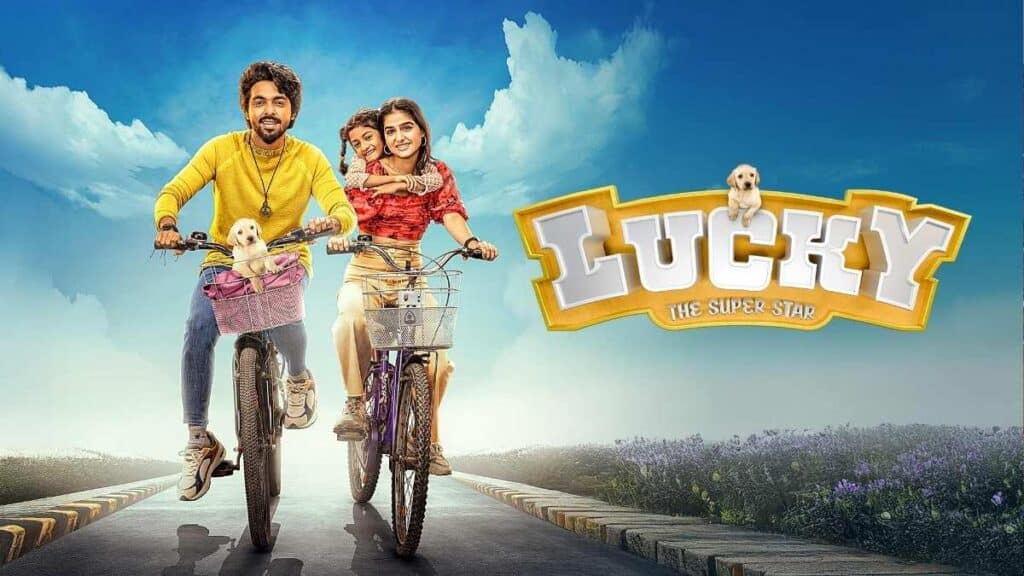
Released on JioHotstar on February 20, 2026, this 138-minute Tamil children’s fantasy directed by Uday Mahesh tells the story of a puppy separated from his mother during a flood, the autistic child he helps heal, and the corrupt politicians who try to exploit his “lucky” fortune. Starring GV Prakash Kumar and Anaswara Rajan, with voice work from Kovai Sarala as the mother dog, it’s a film that wears its emotional sincerity on its sleeve while struggling with weak VFX and predictable storytelling.
The result is imperfect but genuinely affecting—the kind of movie where you’re aware of the technical limitations and narrative shortcuts but find yourself tearing up anyway when the dog and the child connect. And for family audiences—especially those with young children or deep affection for animals—that emotional authenticity might be enough.
Table of Contents
Cast and Performances
GV Prakash Kumar plays Lakshmanan with restrained, grounded emotion. This isn’t a showy performance—it’s deliberately muted, which suits the character of a man carrying family responsibility and the weight of caring for his autistic niece. Prakash has done enough masala films to know when to dial it down, and here he lets the quieter moments breathe rather than filling them with unnecessary energy.
Anaswara Rajan delivers what the review notes describe as a “subtle, mature portrayal.” Playing Ammu, the autistic child whose emotional walls Lucky helps break down, she brings sensitivity to a role that could easily have become caricature. The film’s emotional core depends heavily on her performance, and she delivers.
Kovai Sarala provides voice work for Lucky’s mother dog, adding “warmth and humor” to what could have been a purely sentimental role. Her voice is recognizable enough to Tamil audiences to create immediate emotional connection, but she doesn’t overwhelm the character—she serves it.
The supporting cast, including Motta Rajendran and Devadarshini, fill their roles competently without being given material that allows them to shine beyond functional presence.

CHECK MORE ON:Mana Shankara Vara Prasad Garu Trailer Review
Film Overview
| Detail | Information |
|---|---|
| Title | Lucky The Superstar |
| Director | Uday Mahesh |
| Lead Cast | GV Prakash Kumar, Anaswara Rajan |
| Voice Performance | Kovai Sarala (mother dog) |
| Supporting Cast | Motta Rajendran, Devadarshini |
| Runtime | 2 hrs 18 mins (138 minutes) |
| Platform | JioHotstar (OTT Exclusive) |
| Release Date | February 20, 2026 |
| Languages | Tamil (with Hindi, Telugu, Malayalam, Kannada dubs) |
| Genre | Children’s Fantasy, Family Drama, Political Satire |
| Budget | ₹20 crore (reported) |
What Is Lucky The Superstar About?
The story begins with a flood that separates a mother dog from her “lucky” puppy. That puppy, Lucky, eventually enters the life of Lakshmanan (GV Prakash Kumar) and his autistic niece Ammu. Lucky’s presence begins to bring emotional healing to this family still processing trauma and struggling with Ammu’s isolation.
Meanwhile, corrupt local politicians learn about Lucky’s reputation for bringing fortune and attempt to exploit the dog for electoral gain—a light political satire thread that runs through the film without ever becoming its primary focus.
The plot is straightforward, perhaps too much so. The beats are familiar to anyone who’s seen animal-centered family dramas: separation, connection, healing, external threat, resolution. The review notes acknowledge this directly: the film has a “predictable second half” and “logical inconsistencies.” But the emotional sincerity with which these familiar beats are executed is what gives the film its value.
The central relationship—Lucky helping Ammu emotionally open up—is described as the “central emotional anchor,” and it’s where the film invests most of its care and attention.
What Works: The Emotional Sincerity
The review materials identify several genuine strengths that elevate Lucky The Superstar above its technical limitations:
Strong child-dog bonding. This is the film’s primary achievement. The connection between Lucky and Ammu is developed with patience and genuine warmth. The film understands that this relationship is why family audiences will watch, and it doesn’t shortchange that investment.
Sensitive portrayal of special needs. The film approaches Ammu’s autism with care rather than melodrama. The review notes praise the “sensitive portrayal of special needs”—meaning the film treats this as part of Ammu’s character rather than the entirety of her identity or a problem to be “fixed” by the dog’s magic.
Family-friendly tone. The film maintains accessibility for children throughout its 138-minute runtime. The political satire remains light rather than dark, the emotional moments are cathartic without being traumatic, and the overall atmosphere stays warm and optimistic.
Performances that elevate material. The review assessment is clear: “Performances elevate otherwise predictable writing.” When the script gives the actors familiar beats, they deliver them with enough authenticity to make them feel earned rather than mechanical.
Whimsical background score. The music supports emotional arcs without overwhelming them, helping maintain the lighthearted pacing that makes the film accessible for its target audience.
The critical assessment captures this balance: “The emotional sincerity outweighs narrative flaws for family audiences.” This is a film that knows what it’s doing emotionally even when it stumbles technically.
What Doesn’t Work: The Technical and Narrative Limitations
The review materials are equally clear about the film’s significant weaknesses:
Weak and unrealistic VFX. This is cited repeatedly as a primary limitation. For a film that relies on a dog as its central character and presumably needs VFX for certain action or fantasy sequences, having “weak and unrealistic VFX” undermines believability. The review notes that “some exaggerated dog action sequences reduce believability”—suggesting the film tries for spectacle beyond what its budget can convincingly deliver.
Themes the Film Explores
Healing Through Connection: The central theme is how emotional connection—particularly the unconditional love between a child and a pet—can facilitate healing from trauma and isolation. Ammu’s journey from emotional withdrawal to openness is the film’s primary narrative arc.
Family and Responsibility: Lakshmanan’s character represents the weight of family responsibility, particularly caring for a child with special needs. The film explores how that burden can be lightened through unexpected sources of joy and connection.
Small-Town Political Opportunism: The political satire thread examines how politicians exploit anything—even a beloved dog—for electoral gain. This commentary remains light rather than biting, keeping the film family-friendly.
Destiny and Fortune: The concept of Lucky being a “lucky” dog who brings fortune explores ideas about fate, belief, and how we project meaning onto the things we love.
The thematic work isn’t deep or particularly original, but it’s sincere and appropriate for the target audience.
Genuine Family Watch
Lucky The Superstar is exactly what it claims to be: a heartwarming Tamil children’s fantasy that prioritizes emotional connection over technical polish. With a reported budget of ₹20 crore, weak VFX, and predictable storytelling, it won’t satisfy viewers seeking cinematic excellence. But for families with children, animal lovers, and anyone who values sincere emotional storytelling over perfect execution, it offers genuine warmth.
The film succeeds where it matters most to its target audience: the dog-child bonding is authentic, the performances elevate familiar material, and the emotional beats land despite the predictable structure. GV Prakash Kumar delivers restrained work, Anaswara Rajan brings sensitivity to a delicate role, and Kovai Sarala’s voice adds warmth.
The weaknesses are real and repeatedly noted: the VFX don’t meet even modest expectations, the second half follows an obvious formula, logical inconsistencies will bother attentive viewers, and the 138-minute runtime is longer than ideal for children’s entertainment.
Overall Rating: 3.5/5
A wholesome OTT watch—especially for pet lovers and children—but not a technically polished masterpiece. Heart over logic. Warmth over perfection. And sometimes, for the right audience at the right moment, that’s exactly enough.
Now streaming on JioHotstar in Tamil with Hindi, Telugu, Malayalam, and Kannada dubs.
Lucky The Superstar is an emotionally sincere Tamil children’s fantasy that chooses heart over technical execution. Weak VFX and predictable storytelling limit its cinematic impact, but strong child-dog bonding and grounded performances from GV Prakash Kumar and Anaswara Rajan make it a worthwhile family weekend watch. Perfect for animal lovers and children despite its flaws. 3/5.
Is Lucky The Superstar appropriate for young children?
Yes, the film maintains a family-friendly tone throughout. The review describes it as “children-centric narrative” with “lighthearted pacing” that makes it “accessible for children.”
How does the film handle the portrayal of autism?
According to the review, the film offers a “sensitive portrayal of special needs,” treating Ammu’s autism with care rather than melodrama.
What does “heart over logic” mean in the context of this film?
This phrase (quoted from the review materials) means the film prioritizes emotional authenticity and sincere character connections over narrative coherence or logical plot construction.
