


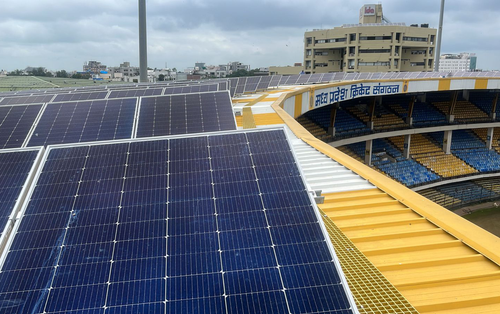
An estimated $110-120 billion is anticipated to be invested in India’s renewable energy sector in the coming years, with a focus on solar and wind projects. By 2030, these projects are projected to present a $10–15 billion opportunity in land aggregation and acquisition, driven by the government’s commitment to cleaner energy sources and achieving net zero emissions. The renewable energy capacity in India currently stands at 251 GW, with an additional 270-300 GW expected from solar and wind energy by 2030, marking a phase of rapid growth.
This expansion is foreseen to offer significant prospects for the real estate sector, particularly in land, industrial, and warehousing segments. CEO and Managing Director at Colliers India, Badal Yagnik, highlighted that renewable energy will not only expedite India’s decarbonization efforts but also stimulate growth corridors and investment destinations, fostering sustainable long-term development across the nation. With non-fossil sources accounting for 51% of the existing capacity and advancements in domestic manufacturing, India is on track to achieve its goal of 500 GW non-fossil-based capacity by 2030.
Land aggregation and acquisition typically represent 10–12% of total costs for solar and wind projects. In solar projects, land is usually acquired by private developers or central/state-level authorities for larger parks. For wind projects, land is obtained for constructing electrical substations and critical infrastructure, with turbine sites often secured through leasing arrangements. As renewable projects expand, the Original Equipment Manufacturer (OEM) segment is expected to drive demand for industrial and warehousing spaces in India significantly.
