


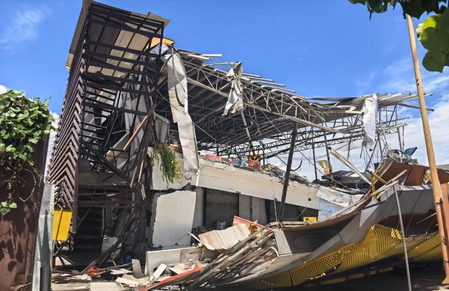
At least 61 people lost their lives, 40 are missing, and 1,403 sustained injuries due to a powerful 7.8 magnitude earthquake that struck off the southern coast of Mindanao, the Philippines, on June 8. The National Disaster Risk Reduction and Management Council provided these figures, along with the impact on over 75,300 households and more than 346,000 individuals. Additionally, the quake caused damage to over 12,600 houses and triggered 45 related incidents, mainly landslides.
The earthquake disrupted the operation of 45 road sections, eight bridge sections, an airport, and two seaports. It also affected various industries such as agriculture, husbandry, and fishery. Power services were disrupted in 48 cities and municipalities as a result of the seismic activity. The Philippine Institute of Volcanology and Seismology reported that the earthquake, which occurred at a depth of 33 km, had its epicenter southwest of the coast of Maasim town in Sarangani province on Mindanao Island.
Junie Castillo, spokesperson for the Philippines’ Office of Civil Defence, mentioned that 10 casualties were reported in General Santos, with at least 12 individuals still missing. The fatalities were attributed to falling debris, building collapses, and landslides. The Philippine National Police confirmed that at least 134 people sustained injuries.
A school building in General Santos collapsed, trapping students inside, while university and restaurant buildings in affected areas also suffered structural damage. Videos circulating online captured the devastation caused by the earthquake, showing collapsed buildings and panicked residents seeking safety outdoors. The earthquake struck shortly after schools had reopened following the summer break, affecting a significant number of educational institutions across multiple regions.
