


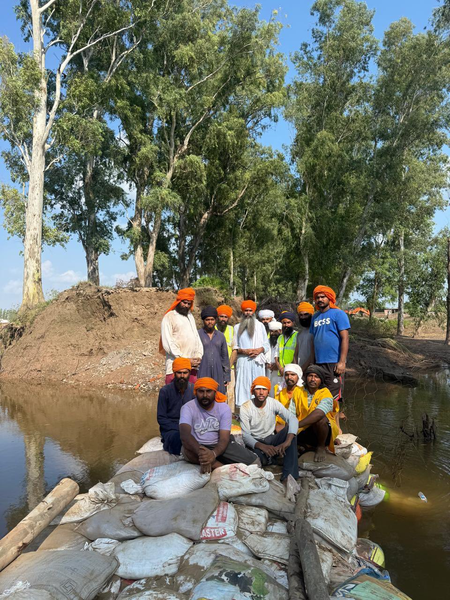
Chandigarh, Sep 11 (IANS) As water from most of the marooned villages in Punjab has started receding and the communities impacted by catastrophic floods are provided with relief material to support daily living, what they need now is long-term rehabilitation, besides medical care to prevent health issues.
Field reports indicate a notable spike in the transmission of water and vector-borne diseases, such as typhoid, cholera, and malaria, among others.
Also, there is a rise in snakebite cases. Carcasses of hundreds of animals, including buffalo and hens, are now piled up in the village’s farms, posing outbreaks of disease and economic damage.
Numerous non-profit organisations have been advocating good hygienic practices and safe food preparation techniques by educating communities, largely rural, not to use flood water to wash dishes, brush teeth or wash and prepare food.
The sudden water releases from major dams, Bhakra, Pong and Ranjit Sagar, after days of heavy rain in hilly areas, resulted in flooding in the Sutlej, Beas, and Ravi rivers downstream, breaching canals’ embankments, and ruining matured paddy saplings.
It is the worst flood in four decades, which claimed 53 lives and destroyed crops sown over 1.91 lakh hectares, with 2,185 affected villages in 22 districts and displaced 388,466 people.
According to the government bulletin on Wednesday, 91 more people were rescued, taking the total number of evacuees to 23,297.
At present, 115 relief camps are operational across the state, accommodating 4,533 people. Still, farmers are unable to reach their houses as the connecting roads have been destroyed, leaving them in suspense about the fate of their animals.
Britain-based charity organisation is on the ground. It has joined hands with doctors of the Punjab Institute of Medical Sciences of Jalandhar to reach out to flood-affected areas with timely medical aid.
“I had more than 20 buffalo and many hens in my farmhouse. When I visited the shed days after the floods, many of them died due to flood water or starvation,” said Nachattar Singh, a distressed farmer in a village in Ferozepur.
He said most of the villages fled from their homes and have not come back as the mud is dangerous.
“The carcasses have begun to decompose,” he added.
Environmentalist Sant Balbir Singh Seechewal, who hogged the limelight after reviving the almost dead 160-km-long Kali Bein, a rivulet sacred to the Sikhs, has been on the ground in Sultanpur Lodhi’s Mand for nearly a month.
With water starting to recede, he asked the ‘sangat’ to voluntarily offer soil, diesel, tractor-trailers, sacks, etc, for the village rehabilitation projects.
In a video posted on his Facebook page on Thursday, he was riding on a motorboat just above the submerged paddy fields.
With the decline in waterlogging, even the plying of boats is becoming difficult. Punjab has 900 km of earthen embankments along the Sutlej, Beas, Ravi, and Ghaggar rivers. These include 226 km along the Sutlej, 164 km along the Ravi, 104 km along the Beas, and nearly 100 km along the Ghaggar. In addition, there are about 300 km of temporary embankments around smaller rivers and streams. These embankments were built in the 1950s and 60s, but this year’s floods have broken all previous water records.
Rajya Sabha member Sant Seechewal suggested that to strengthen these embankments, permanent roads should be built on them and trees planted along the way.
According to him, the simplest way to prevent floods is to plant at least five trees in every field or at each tubewell.
Punjab has about 1.4 million tubewells, and if five trees are planted at each, it would increase to 7 million trees. These trees would help reduce floods and also ensure timely rainfall.
With the receding of floodwater, Sakshi Sawhney, Amritsar’s first woman Deputy Commissioner, told IANS that now medical teams and ASHA workers are visiting door-to-door to deliver medicines to families and raise awareness about health measures like drinking clean water, protecting against mosquitoes, and maintaining personal hygiene.
Teams of global disaster relief charities have been working for those displaced by providing temporary shelters until their homes can be repaired.
They have procured boats from Dubai to reach out to victims and are providing basic household amenities like bedding, furniture, sanitation facilities, and cooking equipment.
Financial assistance and support programmes are also provided to help flood-affected people rebuild their lives.
Observers say the disaster has not changed Punjab; in fact, Punjab has changed the disaster.
“Punjab has changed the way of dealing with the floods,” the observers said.
(Vishal Gulati can be contacted at vi******@**ns.in)
–IANS
vg/svn
