


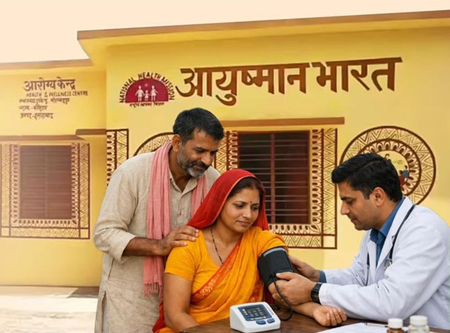
The Ayushman Bharat Digital Mission (ABDM) by the government has developed one of the world’s largest digital health ecosystems, connecting over 104 crore health records to more than 93 crore Ayushman Bharat Health Account (ABHA) accounts. This initiative aims to streamline healthcare services, reduce paperwork, minimize hospital waiting times, and facilitate seamless interactions between patients, hospitals, doctors, and insurers through a unified digital network.
Launched in September 2021, ABDM focuses on creating a citizen-centric digital healthcare ecosystem to enhance accessibility, efficiency, and interoperability of healthcare services nationwide. ABHA acts as a secure digital health identifier that links individuals to their medical records across various healthcare entities with the patient’s consent.
Under ABDM, the government introduced Aarogya Setu 2.0, a citizen-oriented digital health application. This platform enables users to establish ABHA accounts, manage digital health records, schedule teleconsultations and hospital appointments, access insurance details, locate nearby healthcare facilities, and monitor personal health using wearable devices.
The National Health Authority’s ‘Scan and Share’ service, as highlighted in the official fact-sheet, has notably reduced outpatient registration time at hospitals. Over 23.21 crore ABHA-linked digital tokens were generated at healthcare facilities by June 18. To date, hospitals have received incentives exceeding Rs 107 crore, while diagnostic centers, laboratories, pharmacies, and digital solution companies have also been disbursed over Rs 2.95 crore and Rs 26 crore, respectively.
Furthermore, more than 2,200 healthcare facilities have been integrated through the ‘e-Sushrut Clinic’ platform, a lightweight hospital management information system developed by the Centre for Development of Advanced Computing (C-DAC). This system aids smaller clinics in digitizing patient records and administrative processes.
