


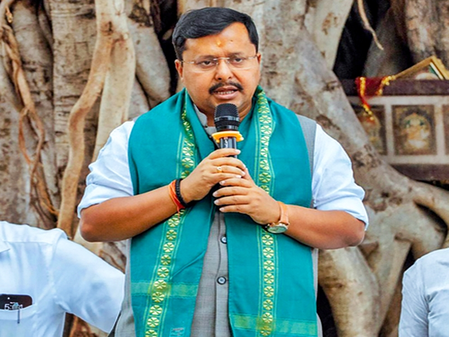
The Bharatiya Janata Party (BJP) has officially started the election process for its upcoming national president. Senior leaders submitted nomination papers for Nitin Nabin, the 45-year-old national working president, at the party headquarters in New Delhi. BJP President J.P. Nadda and Defence Minister Rajnath Singh were among the first to file nominations in the presence of Home Minister Amit Shah and other key leaders.
Additional sets of nominations were presented by leaders from various states, demonstrating widespread support for Nabin. Notable figures like Chief Ministers Yogi Adityanath, Pushkar Singh Dhami, Nayab Singh Saini, and Pramod Sawant, along with representatives from several states, participated in the event. Nabin, appointed as national working president on December 14, 2025, is poised to become the BJP’s 12th national president, with strong backing from Prime Minister Narendra Modi and other senior party members.
Expected to be elected unopposed, Nabin has no rival candidates in the running. The electoral college, comprising members of the national and state councils, is likely to support his candidacy. As per party regulations, a candidate must secure joint proposals from at least 20 members of the electoral college from a single state and have a minimum of 15 years of party membership.
Nominations could be withdrawn between 5 p.m. and 6 p.m. on Monday, with the Returning Officer set to issue a statement at 6.30 p.m. If uncontested, the formal announcement of the new president is scheduled for Tuesday, January 20, 2026. Bihar Deputy Chief Minister Samrat Choudhary praised the development as a proud moment for the state and a significant milestone for the party.
Nabin, a five-time MLA from Bihar, is known for his organizational skills and has been instrumental in forming alliances. Since taking on the role of working president, he has focused on preparations for upcoming Assembly elections in several states. His elevation is viewed as a strategic move to infuse youthful energy into the BJP’s leadership while maintaining its core ideological and organizational principles.
