


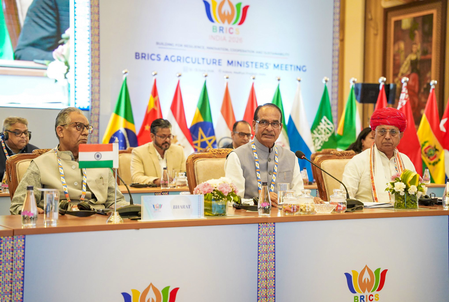
The BRICS Agriculture Ministers’ meeting in Indore wrapped up with the adoption of the ‘Indore Declaration’, emphasizing commitments to food security, climate resilience, sustainable farming, and farmer empowerment. Key discussions centered on ensuring food security, promoting agricultural trade, advancing sustainable practices, and enhancing innovation and partnerships. India, as the host under its BRICS Presidency, brought together around 100 delegates to address these critical agricultural issues.
Union Minister Shivraj Singh Chouhan hailed the outcome as a message of hope and collective responsibility, highlighting the significant global impact of BRICS nations that represent a substantial portion of the world’s population and agricultural production. The meeting focused on challenges faced by small farmers, with a strong emphasis on addressing their needs for inputs, credit, fair prices, and market access. The ‘Indore Declaration’ introduced four new initiatives to translate commitments into actionable steps.
These initiatives include the establishment of a BRICS Network of Centres of Excellence on Agro-Ecology and Regenerative Agriculture, a Digital Agriculture Network, a Global Forum on Farmers’ Rights in Seed Systems, and the BRICS AgriN Network. The declaration also underscores the importance of addressing climate change, El Niño impacts, food loss, and rising fertilizer prices, with a commitment to promoting sustainable agricultural practices and innovation.
The ‘Indore Declaration’ not only highlights the achievements and commitments of India in agriculture but also positions BRICS as a key player in fostering sustainable and resilient food systems globally. The focus on youth and women participation, support for agri-startups, and efforts to enhance technology exchange aim to benefit millions of farmers and enhance global food security in the future.
