


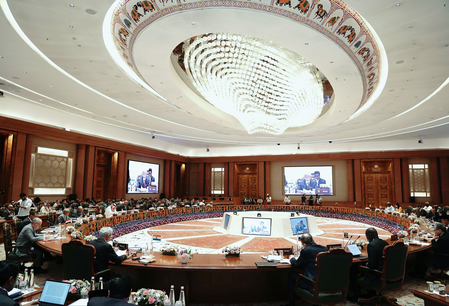
The recent BRICS Foreign Ministers’ Meeting in New Delhi, held under India’s 2026 chairship, demonstrated the bloc’s ability to navigate intense geopolitical challenges. Despite the Gulf War tensions, the forum managed to insulate its core agenda effectively. The meeting, which took place on May 14-15, resulted in a decision not to release a joint statement but rather a ‘Chair’s Statement and Outcome Document’.
Following the meeting, India’s Sherpa for BRICS and Secretary in the Ministry of External Affairs, Sudhakar Dalela, emphasized that the document reflected the members’ “common position” on most issues. The extensive 63-paragraph document indicated progress in advancing the central BRICS agenda, despite ongoing differences over the Gulf War. The meeting, anticipated to involve direct confrontations, saw calls for dialogue and diplomacy to resolve conflicts in the Middle East.
External Affairs Minister S Jaishankar, as the BRICS chair, acknowledged the differing views among members regarding the West Asia/Middle East situation. Participants emphasized the need for dialogue, respect for sovereignty, and protection of maritime trade routes and civilian infrastructure. The meeting served as a bridge between the 2025 Rio de Janeiro summit and the upcoming summit in Delhi, scheduled for September this year.
The outcome document of the meeting aligned with India’s key priorities, including UN Security Council reform, disaster management, food security, Digital Public Infrastructure (DPI), and counterterrorism efforts. Despite initial concerns, the meeting showcased the unity and progress within the BRICS framework, dispelling notions of its decline.
