


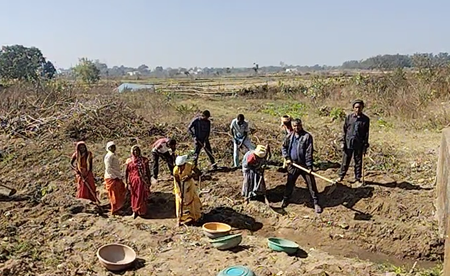
The decision to replace the Mahatma Gandhi National Rural Employment Guarantee Act (MNREGA) with the Viksit Bharat Grameen Rozgar Ajeevika Mission (Grameen) – VB G RAM G has stirred controversy, leading to a clash between the Opposition and ruling parties over the name change rather than a discussion on the new law’s pros and cons. Despite the political debate, workers from impoverished backgrounds benefiting from MNREGA are pleased with the enhancements introduced in the new VB – G RAM G law.
In Chhattisgarh’s Dhamtari district, farmers and laborers have expressed their initial reactions to the new legislation, welcoming the extension of wage limit days from 100 to 125. They are optimistic about the new provisions, anticipating longer stays in their villages. The Central government’s initiative is seen as a significant advantage by these workers, who will now have 125 days of employment opportunities in their localities.
Local workers, such as Vinita, have lauded the new law for its positive impact on their livelihoods. Vinita highlighted the increase in workdays from 100 to 125, expressing gratitude to the government for the improved income prospects. Dalu Sahu and his family also expressed satisfaction with the law, emphasizing the rise in income and the assurance of steady employment.
Nand Yadav, the president of the workers’ union, endorsed the ‘VB G RAM G’ law, emphasizing its benefits for the workforce. He praised the law for ensuring 125 days of employment, timely wage payments either weekly or within 15 days, and direct online crediting of wages to workers’ accounts. Yadav believes that this scheme will not only boost workers’ income but also strengthen their families.
The new VB G RAM G law guarantees 125 days of wages for unskilled workers from impoverished households, offering unemployment benefits if work is not provided within the specified period. Additionally, workers are entitled to interest if wage payments are delayed beyond 15 days.
