


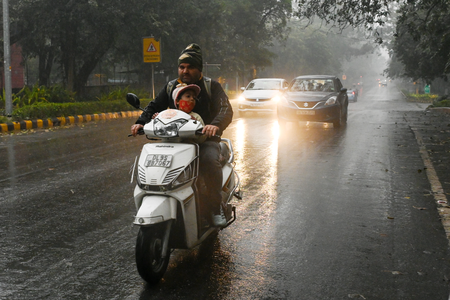
The Delhi-NCR region encountered moderate rainfall on Tuesday morning, ushering in a fresh wave of winter chill. The India Meteorological Department (IMD) has issued a yellow alert for the city due to the impact of a Western Disturbance. According to the IMD, there may be light rain, thunderstorms, lightning, and gusty winds of 30–40 km/h during the forenoon, with more expected later in the day.
The upcoming week is predicted to have mostly cloudy skies, except for partial cloudiness on January 29 and 31. Additionally, shallow to moderate fog is anticipated during the morning hours from January 28 to February 2. Despite a brief period of improved air quality, pollution levels have escalated again, with the Air Quality Index (AQI) reaching 281, categorizing it as ‘poor’.
The Central Pollution Control Board (CPCB) reported alarming pollution levels in various areas of the national capital. Anand Vihar recorded an AQI of 368, followed by Rohini at 370, Bawana at 344, Sonia Vihar at 337, Chandni Chowk at 325, DTU at 322, ITO at 321, Patparganj at 317, Dwarka Sector-8 at 314, North Campus at 291, and Narela at 288. After recent winter rain, Delhi saw an improvement in air quality, with an AQI of 150, falling under the ‘moderate’ category.
On Monday, temperatures gradually increased, with the 24-hour average AQI settling at 241, remaining ‘poor’. The weather department has cautioned about rain, thunderstorms, lightning, and hail on Tuesday, with wind speeds expected to reach 40-50 kmph and gusts up to 60 kmph. Monday evening temperatures in Delhi displayed mixed trends, with relatively warmer days but persistently cold nights. According to AQI classification, readings from 0 to 50 are ‘good’, 51 to 100 ‘satisfactory’, 101 to 200 ‘moderate’, 201 to 300 ‘poor’, 301 to 400 ‘very poor’, and 401 to 500 ‘severe’.
