


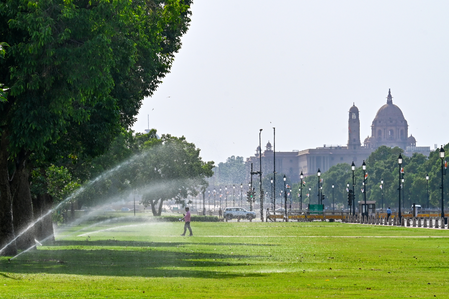
Residents in Delhi-NCR can expect relief from the ongoing heatwave as per the latest forecast by the India Meteorological Department (IMD). Over the next four days, a change in weather patterns is anticipated, bringing lower temperatures and the likelihood of rainfall, thunderstorms, lightning, and strong winds in the region. This shift is also expected to lead to a slight improvement in the Air Quality Index (AQI).
On Tuesday, temperatures are forecasted to range between 40-42 degrees Celsius in Delhi. The city may experience light rain, thunderstorms, and winds gusting up to 50 kmph. Moving to April 29, temperatures are expected to decrease slightly, with the maximum around 40 degrees Celsius and the minimum at approximately 26 degrees Celsius. Thunderstorms, lightning, and strong winds are likely throughout the day.
As we progress to April 30, temperatures are predicted to drop further, with the maximum temperature potentially reaching 38 degrees Celsius and the minimum around 24 degrees Celsius. Skies are expected to be partly cloudy with isolated thunder and lightning in some areas. By May 1, the weather is forecasted to be predominantly clear, with temperatures remaining high at around 40 degrees Celsius for the maximum and 24 degrees Celsius for the minimum.
The Air Quality Index in Delhi and NCR continues to fluctuate between ‘moderate’ and ‘poor’ categories. In Delhi, AQI levels were reported at 227 in Anand Vihar, 205 in Bawana, and 206 in the Cantonment area, indicating ‘poor’ air quality. Meanwhile, areas like Ashok Vihar, Aya Nagar, and Chandni Chowk reported ‘moderate’ air quality levels.
In Greater Noida, AQI levels were recorded at 228 in Knowledge Park-3 and 253 in Knowledge Park-5, falling under the ‘poor’ category. The situation is more severe in Ghaziabad, with AQI levels ranging from ‘poor’ to ‘very poor’ in areas like Indirapuram, Loni, Sanjay Nagar, Vasundhara, and Ved Vihar-Loni. Weather experts suggest that the expected rainfall and strong winds may help reduce dust and pollutant particles in the atmosphere, providing some relief from poor air quality. However, residents are advised to be cautious during thunderstorms and high-speed winds.
Amid a growing heatwave in various parts of India, authorities are taking preventive measures to protect public health, particularly that of students. Schools in Delhi, Noida, and parts of Uttar Pradesh have been advised to adjust their schedules to avoid the peak afternoon heat. Some states have announced summer vacations, while others have opted for temporary closures.
