


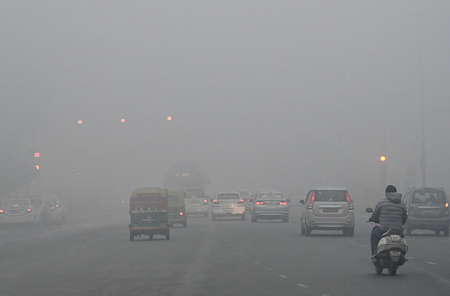
Residents of Delhi faced alarming air quality levels on Sunday morning as a thick blanket of toxic smog and dense fog covered the city, pushing pollution levels into the ‘severe’ category. The situation worsened with a sharp drop in temperatures, leading the India Meteorological Department (IMD) to issue a cold wave alert for several parts of the city. Delhi’s primary weather station at Safdarjung recorded a minimum temperature of 4.4 degrees Celsius, while Ayanagar registered a low of 4.9 degrees Celsius, indicating intensified winter conditions.
According to IMD data, a partly cloudy sky with moderate fog is expected in Delhi, while dense fog may occur at isolated locations during the morning hours. The maximum temperature is forecasted to range between 21 to 23 degrees Celsius, with the minimum temperature expected to hover between 4 and 6 degrees Celsius. Meanwhile, Delhi’s air quality deteriorated sharply, with the city’s 24-hour average Air Quality Index (AQI) reaching 437, categorizing it as ‘severe’ as per the Central Pollution Control Board (CPCB).
Several monitoring stations in Delhi reported AQI levels exceeding 450, placing them in the ‘severe+’ category. Areas such as Wazirpur, Sonia Vihar, Rohini, RK Puram, and others recorded extremely hazardous air quality levels. The weather office issued a nowcast warning for fog at multiple locations due to reduced visibility, prompting the Indira Gandhi International Airport to implement Low Visibility Procedures.
The combined impact of severe air pollution, dense fog, and cold wave conditions has raised health concerns, especially for vulnerable groups like children, the elderly, and those with respiratory issues. Authorities are closely monitoring the situation as winter conditions intensify across the region.
