


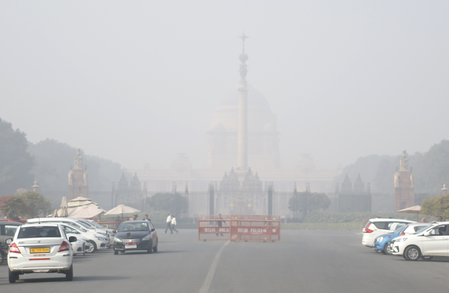
Delhi’s air quality stayed in the ‘poor’ category on Monday morning as the city faced a cold wave. The minimum temperature dropped significantly by 4.5 degrees Celsius, settling at 6.5 degrees Celsius, below the seasonal average.
Area-wise data revealed that the Air Quality Index (AQI) remained in the poor range across most parts of the city. Akshardham recorded an AQI of 294, while ITO registered 256, according to the Central Pollution Control Board (CPCB).
However, 11 monitoring stations reported ‘very poor’ air quality, including Anand Vihar, Ashok Vihar, and Chandni Chowk, known for high pollution levels. Anand Vihar recorded an AQI of 323, Ashok Vihar 304, and Chandni Chowk a particularly high AQI of 343.
Neighboring cities also saw a decline in air quality, with Noida’s AQI worsening to 242 and Gurugram slipping back into the ‘poor’ category with an AQI of 244.
Authorities lifted some restrictions under the Graded Response Action Plan (GRAP) due to improved air quality from rainfall and strong winds. However, GRAP-1 and GRAP-2 measures remain in place as a precaution.
The India Meteorological Department (IMD) forecast a cold wave affecting isolated places in Delhi till January 6, with mainly clear skies and shallow to moderate fog in the mornings.
Delhi’s temperatures are expected to range between 17-19 degrees Celsius for the maximum and 7-9 degrees Celsius for the minimum. Night temperatures varied across the city, with Safdarjung at 7.4 degrees Celsius, Palam at 6.8 degrees Celsius, and Ayanagar at 6.6 degrees Celsius.
IMD also predicted light rain or snowfall in parts of Kashmir, Himachal Pradesh, and Uttarakhand. Kashmir is currently in a cold wave period called ‘Chilla-e-Kalan’, with no snowfall in the plains yet this season.
Cold wave conditions are forecasted in isolated areas of Punjab, Haryana, Chandigarh till January 8, West Rajasthan till January 9, and East Rajasthan till January 10.
