


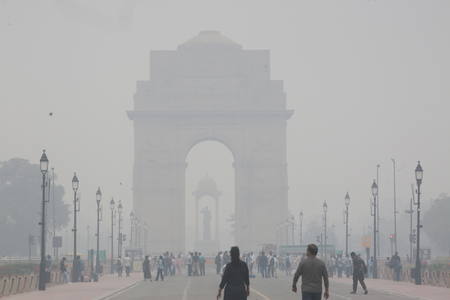
Delhi experienced a slight increase in its minimum temperature, reaching 3.8 degrees Celsius on Wednesday morning. Despite this rise, the cold wave persisted in the city, as reported by the India Meteorological Department (IMD). The air quality in Delhi remained a significant concern, classified as ‘very poor,’ with an overall Air Quality Index (AQI) of 360.
Monitoring stations in various parts of Delhi recorded alarming AQI levels above 300, indicating hazardous conditions for public health. Some areas even entered the ‘severe’ category, with readings surpassing 400. Anand Vihar registered an AQI of 366, Bawana at 361, Jahangirpuri at 420, RK Puram at 407, Dwarka Sector 8 at 403, Punjabi Bagh at 366, Wazirpur at 386, and Chandni Chowk at 397.
The AQI classification ranges from ‘good’ to ‘severe,’ with values between 0 and 50 considered ‘good’ and 401 to 500 categorized as ‘severe.’ Prolonged exposure to ‘very poor’ and ‘severe’ air quality levels can have severe impacts on respiratory and cardiovascular health, especially for vulnerable groups like children and the elderly.
The IMD forecasts that the cold conditions in Delhi will persist throughout the day, with cold wave to severe cold wave conditions expected for the next two to three days before gradually easing. The Meteorological Department predicts maximum and minimum temperatures in Delhi to range between 19 degrees Celsius to 21 degrees Celsius and 3 degrees to 5 degrees, respectively. Visibility fluctuations due to fog have affected flight operations at Hindon Airport, leading to potential changes in flight schedules.
