


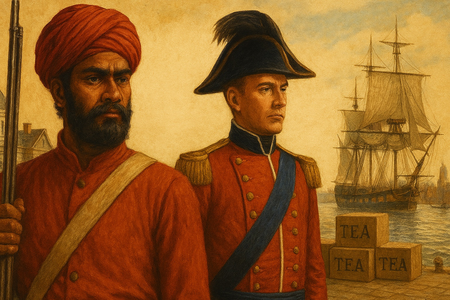
In 1820, the British Parliament introduced the East India Company’s Volunteers Bill to formalize a London infantry corps for protecting the Company’s warehouses. This seemingly minor action sparked outrage in India, revealing how Indian revenues were diverted to fund British interests and maintain the Company’s solvency.
The Bill’s opponents connected the military expense to the EIC’s financial desperation, highlighting the burden of servicing Indian debts on Indian revenue. They criticized the EIC for charging the cost of protecting its London warehouses to Indian taxes, exposing the misuse of Indian funds for commercial security in Britain.
Critics saw the Volunteers Bill as a step towards military despotism, questioning the need for a volunteer corps in peacetime London. They contrasted this with the immense military force in India, funded by Indian subjects, and criticized the prioritization of British interests over justice and legal claims in India.
The passage of the Volunteers Bill affirmed the EIC’s financial supremacy over political accountability, symbolizing the exploitation of India’s resources for British interests. This act epitomized the EIC’s imperial exploitation, where Indian revenues were used to fund the security of British assets, showcasing the company’s disregard for Indian welfare and financial stability.
