


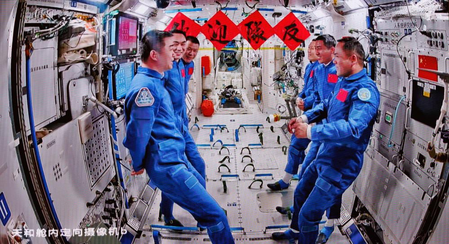
Of the four mice sent into space aboard China’s space station, one female has successfully delivered healthy offspring on Earth. The mice, two males and two females, were part of the Shenzhou-21 crewed spaceship mission on October 31. After returning on November 14, one female mouse gave birth to nine pups on December 10, with six surviving.
Researchers have confirmed that the mother mouse is nursing normally, and the pups are active and healthy. This successful mission indicates that short-term space travel did not affect the reproductive ability of the mouse. It also provides valuable insights into how the space environment impacts early mammalian development.
The mice, chosen for their genetic similarity to humans and other advantages, were raised in orbit for five to seven days. This marked China’s first scientific experiment involving mammalian models in space. The project, led by the Chinese Academy of Sciences, included continuous video monitoring of the mice during their time in orbit.
The mice were provided with a controlled environment, including balanced nutrition and cleanliness measures. The researchers aimed to study stress responses and adaptation mechanisms in microgravity to understand how weightlessness and confined spaces affect the behavior of mice. After completing their mission, the mice returned to Earth for further analysis.
