


Dehradun, Aug 7 (IANS) Uttarakhand Cabinet on Friday gave its nod to a slew of landmark decisions that are likely to have wide-ranging implications for the state’s education, employment, rural economy, and industrial development, and are also expected to give momentum to public welfare.
The most notable decisions include allotment of 30 hectares of land for a new High Court complex in Haldwani and extension of the Ganga Expressway to Haridwar. Other decisions included approval for the Uttarakhand Code on Wages Rules, giving impetus to eco-tourism and boosting potable water supply through the Jal Jeevan Mission.
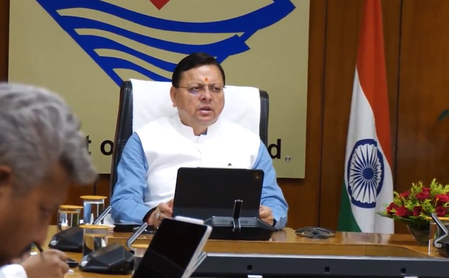
“The Uttarakhand Cabinet approved a proposal to transfer approximately 30 hectares of land, out of the 73 hectares of forest land available in the Lamachaur area of Haldwani, for the construction of the High Court complex,” said officials after the conclusion of the cabinet meet, chaired by Uttarakhand CM Pushkar Singh Dhami.
Below are some important decisions taken by the Dhami cabinet:
Subsidy on purchase of cows and buffaloes for livestock owners
To expand the scope of the cattle rearing scheme, the Cabinet has decided to include livestock owners from the general category.
Beneficiaries will now have the option to purchase buffaloes in addition to cows. The unit cost per animal has been raised from ₹40,000 to ₹60,000. Beneficiaries from Scheduled Castes and Scheduled Tribes will receive a subsidy of up to 90 per cent, while those from the general category will receive up to 60 per cent.
As per the government’s estimates, the initiative is expected to benefit over 2,000 livestock owners in the first year.
Approval for Uttarakhand Code on Wages Rules, 2026
The Cabinet approved the implementation of the Uttarakhand Code on Wages Rules, 2026, under the Code on Wages, 2019. The key provisions include minimum wage standards, double payment for overtime work, salary disbursement by the 7th of every month, digital payment methods, and ensuring equal pay for men and women for equal work.
New guidelines for SC and ST hostels
A decision was taken to implement the Operational Guidelines, 2026, for hostels managed by the Social Welfare Department.
Boost for Eco-Tourism
The High-Powered Committee (HPC) composition has been amended for promoting eco-tourism. Senior Forest Department officials will be included in the committee to strengthen environmental conservation and bolster coordination with local communities.
Approval for Ordinance to Amend GST Act
A decision was taken to introduce an ordinance amending the Uttarakhand Goods and Services Tax Act, 2017, in line with amendments made by the Central Government.
Creation of 122 posts in State Sports University
Approval has been granted for 122 regular posts, alongside necessary technical and support staff to be hired via outsourcing, to ensure the smooth operation of the Uttarakhand State Sports University at Gaulapar (Haldwani).
New transfer protocol for Jal Jeevan Mission schemes
The Cabinet has decided to implement the Centre’s prescribed protocol within the state for the commissioning of rural drinking water schemes and their subsequent transfer to Gram Panchayats and Village Water and Sanitation Committees.
Ganga Expressway Extension to Haridwar
A Memorandum of Understanding (MoU) between the governments of Uttar Pradesh and Uttarakhand to extend the Ganga Expressway from Meerut to Haridwar was approved. This will give impetus to religious tourism, industrial investment, trade, and employment.
Approval for Uttarakhand Industrial Relations Rules, 2026
The Cabinet decided to implement the Uttarakhand Industrial Relations Rules, 2026, under the Industrial Relations Code, 2020. These rules incorporate significant provisions such as the time-bound resolution of industrial disputes, recognition of trade unions, constitution of grievance redressal committees, clear procedures for strikes and lockouts, and the establishment of a worker re-skilling fund.
The slew of cabinet decisions is set to strengthen the rural economy, boost the income of livestock rearers, protect workers’ rights, provide better facilities for students, expand sports and judicial infrastructure, promote eco-tourism, improve drinking water management, and give a new direction to industrial and infrastructural development.
–IANS
mr/dan
