


Nearly 25 crore people have been lifted out of multidimensional poverty in the last 12 years due to enhanced welfare programs and social protection initiatives, as per government statements. Progress has been noted in areas such as tap water coverage, sanitation, health security, food security, and female primary school enrollment. Rural tap water coverage has surged from 3.23 crore households in 2019 to 15.84 crore in 2026, with 2.77 lakh villages achieving full tap water coverage under the Har Ghar Jal campaign.
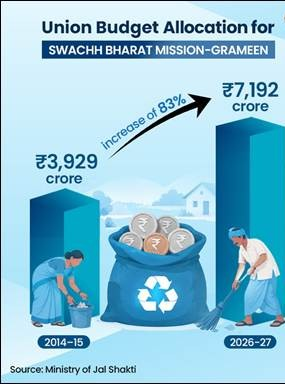
Over 12.11 crore household toilets have been constructed, leading to universal rural sanitation coverage from 39% in 2014. The PM Ujjwala Yojana has provided more than 10.57 crore free LPG connections, benefiting women’s health and reducing indoor pollution. Multidimensional poverty has notably decreased from 29.17% in 2013–14 to 11.28% in 2022–23, reflecting a substantial 17.89 percentage-point drop.
Average inflation has also seen improvement, declining from 8.1% (2004–2014) to 5.1% (2014–2025), thereby enhancing household purchasing power. Initiatives like the Jal Jeevan Mission have significantly boosted health, education, and socio-economic status in rural areas. The scheme’s fiscal allocations have surged by about 488% between 2020–21 and 2026–27, amounting to Rs. 67,670 crore.
The government has highlighted the positive impacts on health and food security, with Ayushman Bharat expanding healthcare access for economically vulnerable families and PM Garib Kalyan Anna Yojana providing free food grains to over 81 crore beneficiaries. Notable progress has been made in female primary school dropout rates, decreasing from 4.6% in 2013-14 to 0.3% in 2024-25. Various digital governance reforms have enabled Aadhaar-based ration delivery and expanded welfare services in Aspirational Districts and tribal regions.
Initiatives like Beti Bachao Beti Padhao have aimed to counter gender-biased sex-selective practices and improve the Child Sex Ratio. The sex ratio has shown improvement from 943 females per 1,000 males in 2011 to 1,020 females per 1,000 males in 2021. Additionally, secondary school enrollment for girls has risen from 75.51% in 2014–15 to 80.2% by 2024–25.
