


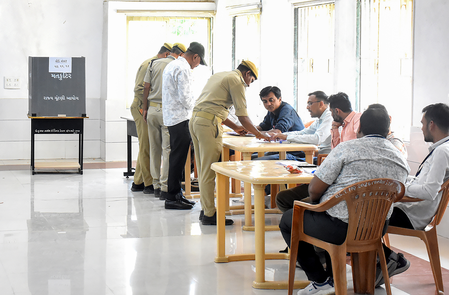
Voting for Gujarat’s vast local body elections, encompassing 393 self-government institutions, is scheduled for Sunday. The elections cover 15 municipal corporations, 84 municipalities, 34 district panchayats, and 260 taluka panchayats, marking a significant democratic event. Polling will commence at 7:00 AM and end at 6:00 PM, with the possibility of repolling the next day. Vote counting is slated for April 28.
These elections hold immense importance as they are seen as a crucial gauge of public opinion before the upcoming Gujarat Assembly elections towards the end of next year and the general elections within the next two years. Over 4.18 crore voters are eligible to participate, with a high turnout anticipated at nearly 50,000 polling stations. A total of 9,992 local representatives are up for election, with over 20,000 candidates remaining after withdrawals and some already elected unopposed.
The electoral competition involves multiple parties, including the Bharatiya Janata Party (BJP), Congress, Aam Aadmi Party (AAP), and independent candidates competing statewide. The BJP currently controls the municipal corporations of Ahmedabad, Surat, Vadodara, and Rajkot, which are politically significant and likely to impact the broader electoral scenario. This election cycle is also noteworthy for its implementation under revised reservation norms for Other Backward Classes (OBCs), ensuring 27 percent reservation. The changes necessitated extensive delimitation and ward restructuring in various districts, alongside existing reservations for Scheduled Castes, Scheduled Tribes, and women, expected to reshape local governance in Gujarat.
