


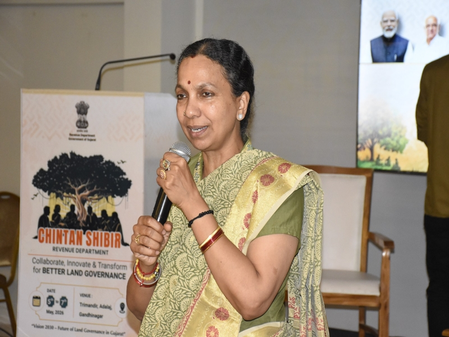
The Gujarat Revenue Department’s Chintan Shibir highlighted the importance of modernizing land governance through digital technologies. Discussions at the event focused on artificial intelligence, blockchain, geographic information systems (GIS), and administrative reforms to enhance transparency, efficiency, and citizen-centric services. The Shibir, held at Amba Business Park in Adalaj, brought together senior officials and experts to explore key aspects of land administration and revenue services.
Additional Chief Secretary Dr. Jayanti Ravi participated in the discussions, where attendees examined ways to simplify procedures and enhance accountability in revenue operations. Various thematic groups delved into topics such as optimizing processes like land use change permissions, expanding paperless property registration systems, and discussing urban land record management frameworks. The sessions also addressed strategies for improving administrative efficiency, disaster preparedness, and challenges related to land acquisition procedures.
Assistant Professor Sameer Kulkarni from IIT Gandhinagar led a technical session on land governance technologies, emphasizing the potential of artificial intelligence and blockchain in revolutionizing revenue systems. Kulkarni explained how blockchain technology can secure land records against tampering, ensuring data integrity and reducing fraud risks. He also discussed the applications of artificial intelligence in revenue administration for document verification, fraud prediction, and faster citizen service processing.
Pankaj Bodani, Deputy Head of VEDAS at the Space Applications Centre of ISRO, presented on the use of GIS and remote sensing in land management. These technologies enable precise land mapping, continuous monitoring, and classification of land use, aiding in water resource assessment and urban development planning. Integration of ISRO satellite data with GIS platforms can enhance land governance, reduce disputes, and support data-driven decision-making in administrative processes.
The discussions at the event aimed to enhance land administration systems by combining policy reforms with technological advancements. The outcomes of the Shibir are expected to guide future initiatives in improving efficiency, transparency, and reliability in revenue services statewide.
