


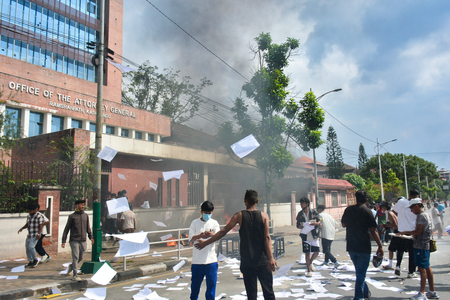
Kathmandu: A violent uprising shook Nepal last week with the so-called Gen Z protestors representing the youth demanding systemic reforms. The upheaval in the Himalayan nation sparked by allegations of political corruption and a social media ban has left at least 72 people dead and more than 1,000 injured. The protesting mobs torched the country’s parliament, hotels, shops and chased politicians after setting fire to their properties. They demanded an end to corruption, more jobs and economic reforms with a more accountable government.
Nepal’s democratic political journey began in April-May 1979 with the students protesting and forcing the monarchy to hold a referendum on the possibility of a multi-party system. The monarchy clamped down on opposition figures. In the later years, every democratic government destroyed the Nepalese idea of a society and institution. This time, the ban on 26 social media platforms revealed networked authoritarianism with the primary purpose to defend state power. The ban was a catalyst for the unrest with protesters having deep seated discontent and dissatisfaction against the Khadga Prasad Sharma Oli government.
Seemingly overnight, the Gen-Z movement provoked students to react and received public endorsements. This student activism in the fragile situation of Nepal with its digital signature of Discord messaging app is shaping Nepal responding to socio-economic and political issues.
36-year-old Sudan Gurung, the founder of Hami Nepal (We are Nepal), mobilised massive demonstrations through the Discord messaging app and Instagram which ultimately forced Oli to resign. Hami Nepal had used VPNs to access banned platforms and urged for action that reached lakhs of young people to join the protest march.
He used proxy names online for security reasons and played a stellar role in high-stakes decisions leading to the appointment of former first woman Chief Justice of Nepal, Sushila Karki, known for her zero tolerance for corruption and respect for the rule of law, as Nepal’s first woman interim Prime Minister till elections are held on March 5, 2026.
Meanwhile, the core committee members of Gen-Z movement, Arjun Shahi and Tanaka Dhami told India Today on September 14 that the Gen-Z movement not only targetted Oli, but all leaders and bureaucrats whose misrule, poor governance and corruption has pushed Nepal to its current state.
Describing the protests as a “do-or-die situation”, both Shahi and Dhami categorically stated the urgency of their mission and vowed to continue until their objectives were met. The leaders of the Gen-Z movement unequivocally conveyed that they are not interested in deciding who should be in the government but will “review and reform the system” to ensure accountability.
The Gen-Z movement has been a revolt against “nepo kids” and the ingrained “elite” flaunting wealth. The movement revealed a sort of inter-generational clash with their slogan “Rise up from every village, rise up from every town” immediately going viral on TikTok, VPNs and messaging platforms. Nepali youth were politically alienated and economically sidelined. However, digitally empowered, this youth confronted the Oli government.
Karki has stated that her government is only a bridge to the elections, asserting that it will have to work according to the thinking of the Gen-Z generation.
The Gen-Z leaders have emphasised that they want other countries, especially India, to invest in Nepal.
For India, Nepal – a predominantly Hindu-majority country – holds a special and unique place. The Himalayan nation has an open border of more than 1750 km with five Indian states, including Uttarakhand, Uttar Pradesh, Bihar, West Bengal and Sikkim. Besides having a large Nepali diaspora, India also has more than 43,000 famed Gurkha soldiers deployed in various parts of the country, including J&K and the Northeast.
While congratulating Karki on assuming charge as the interim Prime Minister, Prime Minister Narendra Modi reaffirmed India’s firm commitment to the peace, progress and prosperity of the neighbouring nation. Karki is a valuable interlocutor having grasp, knowledge and perception of the sensitive strategic bilateral relations. New Delhi and Kathmandu would certainly be interested in securing cross-border trade, restraining potential Chinese inroads into Nepal’s political and economic life and maintaining regional stability.
(The writer is an expert on South Asia and Eurasia. He was formerly with Manohar Parrikar Institute for Defence Studies and Analyses. Views expressed are personal)
–IANS
/as
