


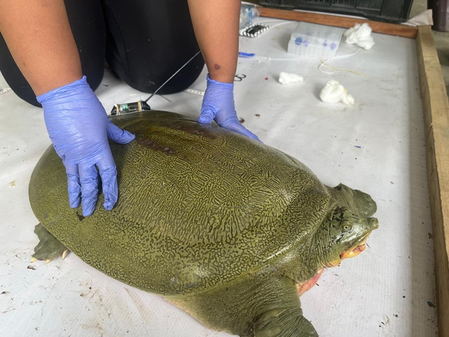
India has reached a significant milestone in wildlife conservation by successfully satellite tagging the endangered Ganges Softshell Turtle in Assam’s Kaziranga National Park and Tiger Reserve (KNPTR). This achievement was announced by Assam Chief Minister Himanta Biswa Sarma on Endangered Species Day, emphasizing the importance of this step in India’s conservation efforts. The initiative marks a historic moment for wildlife conservation in the country.
Assam is recognized as a crucial region for freshwater turtle conservation due to its remarkable turtle diversity, with the state being home to 21 turtle species, making it one of Asia’s most diverse turtle habitats. Notably, Kaziranga alone houses five out of the eight softshell turtle species reported in India.
The Ganges Softshell Turtle, listed under Schedule I of the Wildlife (Protection) Act, is distinguishable by arrowhead-shaped markings on its head. Despite being widely distributed across India in large rivers, lakes, and reservoirs, this turtle species is classified as endangered on the IUCN Red List. These turtles play a vital role in river ecosystems as important predators and contribute to ecological balance by consuming dead and decaying animal matter.
The satellite-tagging initiative, led by a team in collaboration with Kaziranga park authorities and the Assam Forest Department, aims to enhance researchers’ understanding of the species’ seasonal movements, home range, and critical habitats. This effort, supported by the National Geographic Society, is crucial for the active management and conservation of softshell turtles in the Brahmaputra river basin.
Kaziranga National Park and Tiger Reserve, a UNESCO World Heritage Site, is renowned for its rich biodiversity and iconic wildlife species. The successful satellite tagging of the Ganges Softshell Turtle in this protected landscape will contribute significantly to identifying and safeguarding critical habitats for endangered species within Kaziranga’s delicate riverine ecosystem.
