


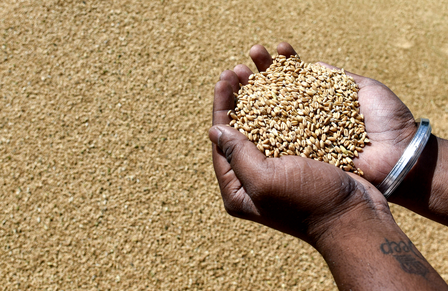
India’s total foodgrain production for 2025-26 has hit an all-time high of 376.563 million tonnes, marking a 5.3% increase from the previous year’s 357.732 million tonnes. The third advance estimates of major agricultural crops released on Wednesday revealed this significant growth. Union Minister for Agriculture & Farmers Welfare Shivraj Singh Chouhan praised this milestone, stating that it represents the highest-ever foodgrain production in the country’s history, showcasing a positive outlook on India’s agricultural progress.
Detailed figures show rice production at 154.024 million tonnes, up from 150.184 million tonnes in the previous year, with wheat production estimated at 120.657 million tonnes, an increase of 2.712 million tonnes compared to last year. Additionally, maize production has soared to a record 55.093 million tonnes, showing a substantial rise of 11.684 million tonnes from the previous year. The production of millets and other cereals has also seen notable growth, with a total output of 74.472 million tonnes.
In the pulses category, tur production remains steady at 3.592 million tonnes, while gram production has increased to 12.514 million tonnes, up by 1.4 million tonnes from the previous year. Lentil production is estimated at 1.762 million tonnes. Moving to oilseeds, the total production is estimated at 43.059 million tonnes, with groundnut production reaching 13.074 million tonnes, soybean production at 12.596 million tonnes, and rapeseed and mustard production at 13.768 million tonnes.
Among commercial crops, sugarcane production has surged to 500.063 million tonnes, showing a substantial increase of 45.452 million tonnes from the previous year. Cotton production is estimated at 29.024 million bales, while jute production stands at 9.176 million bales. The Agriculture Minister highlighted the government’s efforts under Prime Minister Narendra Modi’s leadership, emphasizing the consistent focus on farmers’ prosperity and agricultural sector growth, resulting in record agricultural production.
The third advance estimates underscore the robust production position of foodgrains, major cereals, oilseeds, and commercial crops in the country, with several crops expected to achieve record production levels. The Agriculture Minister also credited the Indian Council of Agricultural Research for its role in enhancing major crop production through agricultural research initiatives, including the development of climate-resilient crop varieties and rainfed production technologies.
In 2025-26, the Indian Council of Agricultural Research introduced 339 crop varieties suitable for different agro-climatic regions, covering cereals, oilseeds, pulses, commercial crops, and fodder crops. The minister highlighted the success of the Viksit Krishi Sankalp Abhiyan, which strengthened agricultural practices nationwide by providing farmers with climate-resilient technologies, improved crop production techniques, and scientific advisory support for holistic agricultural development.
