


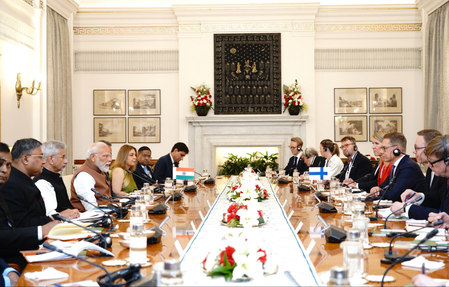
Prime Minister Narendra Modi highlighted the significance of Finland as a key partner for India in the Nordic region. During a joint press meet with Finland President Alexander Stubb, PM Modi announced the expansion of collaboration in Arctic and polar research. The two nations have also agreed to enhance research cooperation in areas such as teacher training, school partnerships, and the future of education.
PM Modi emphasized the growing popularity of Finland among Indian students and professionals. A comprehensive migration and mobility agreement has been signed to foster connections between the innovation ecosystems of both countries. This agreement aims to bolster joint research initiatives and startup collaborations, further strengthening the bilateral relationship.
Recognizing Finland as a role model in education, PM Modi underscored the deepening research cooperation in teacher training, school partnerships, and educational advancement. This commitment signifies a comprehensive collaboration across various levels of human development, extending from educational institutions to industry. The partnership between India and Finland is set to expand into Arctic and polar research, solidifying their ties in diverse fields.
Extending a warm welcome to President Stubb on his inaugural visit to India, PM Modi praised his leadership and intellectual contributions. The Prime Minister expressed delight in having President Stubb as the Chief Guest at the Raisina Dialogue. PM Modi also highlighted the increasing cooperation between India and Europe, emphasizing the positive impact on global stability, growth, and shared prosperity.
PM Modi announced the elevation of India-Finland relations to a strategic partnership focusing on digitalization and sustainability. The collaborative efforts have already led to the completion of significant infrastructure projects in India, including the construction of the world’s highest railway bridge over the Chenab River. The partnership is poised to accelerate cooperation in cutting-edge technologies ranging from AI to 6G telecom, clean energy, and quantum computing, while also expanding into sectors like defence, space, semiconductors, and critical minerals.
