


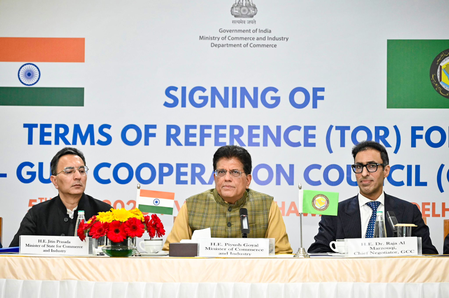
India and the Gulf Cooperation Council (GCC) have decided to restart negotiations on a Free Trade Agreement (FTA) after a fifteen-year hiatus, marking a significant shift in their economic ties. The move signifies a move towards geoeconomic realignments, highlighting a strategic shift from an energy-centric relationship to a broader economic partnership, as per a report.
The revival of FTA talks between India and the GCC goes beyond mere trade discussions; it serves as a strategic indicator of how West Asian countries are adapting to global uncertainties by expanding economic collaborations. Trade diplomacy is increasingly being utilized as a tool for ensuring strategic stability in the region, with the India-GCC FTA reset symbolizing this evolving trend, as noted in a report by India Narrative.
The Gulf states are currently undergoing significant economic transformations, with a focus on mega projects, non-oil industrial expansion, and investments in sectors like manufacturing, logistics, hydrogen energy, and fintech. These developments necessitate closer integration with high-growth Asian markets, with India’s workforce and technological capabilities playing a crucial role, as highlighted in the article.
India, on its part, is actively pursuing trade agreements to secure market access and strengthen its position in resilient supply chains. Recent agreements such as CEPA and FTAs underscore India’s readiness to engage in tariff rationalization and regulatory alignment for strategic gains, signaling a convergence of economic strategies. The resumption of FTA negotiations reflects this evolving economic landscape, the article points out.
The previous FTA talks, which were halted in 2008 due to disagreements on various issues including tariffs and standards, are now being revisited in a changed geopolitical and economic environment. The potential FTA holds promise for India, offering enhanced export competitiveness in sectors like pharmaceuticals, agro-products, textiles, machinery, and IT services, while also presenting opportunities for the GCC nations to diversify their markets and leverage India’s consumer base and industrial capabilities.
The proposed FTA aligns with India’s broader connectivity aspirations, particularly the India–Middle East–Europe corridor (IMEC), indicating a mutual interest in establishing trade routes connecting South Asia to Europe through West Asia. The FTA framework could play a crucial role in supporting the legal and regulatory framework for these transport and logistics networks, further enhancing economic cooperation between the regions.
