


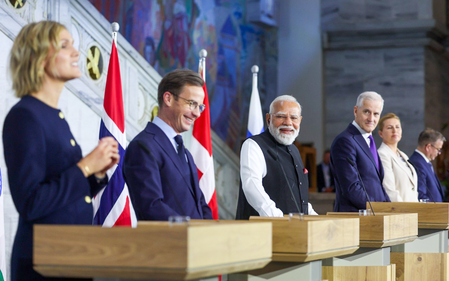
The India-Nordic Summits have played a crucial role in fostering structured dialogue between New Delhi and the five Nordic countries, focusing on maritime security, the blue economy, and sustainable infrastructure. These summits signify India’s strategic efforts to integrate itself into the evolving global supply chain dynamics among democratic economies. A recent report highlighted the significance of the Northern Sea Route (NSR) becoming a key commercial and strategic pathway due to climate change, potentially reducing shipping distances between East Asia and Europe by almost 40%.
India sees the NSR development not just as a logistical advantage but as a pivotal moment in its strategic positioning at the crossroads of the Indo-Pacific and Northern European realms. The report emphasized India’s growing strategic maturity in observing how the Nordic-Baltic Eight nations have restructured their security frameworks post their NATO affiliations. These countries now perceive the Euro-Atlantic and Indo-Pacific regions as interconnected strategic domains, prompting India to engage meaningfully with the Nordic-Baltic nations while safeguarding its strategic autonomy.
The report underscored the strategic and economic rationale behind India’s involvement in the Arctic region, citing the potential benefits of a functional NSR in reducing transit times for global trade, cutting fuel costs, and curbing carbon emissions. It also noted the alignment between Nordic expertise in green shipping, offshore wind, and Arctic infrastructure with India’s green transition goals. The report advocated for India to adopt a proactive stance in leveraging the opportunities presented by the opening of the Northern Route to shape regional governance and enhance its influence.
Emphasizing the urgency for India to act decisively in the Arctic, the report recommended seizing the initiative to define engagement rules rather than passively accepting terms as a late entrant. It urged India to capitalize on the melting ice and evolving opportunities in the region, aligning with its strategic acumen in playing the long game and asserting its presence in the Arctic domain.
